


Selecting the right steel plate silo is a strategic decision that directly impacts operational efficiency, material preservation, and long-term capital returns. This engineering-driven guide systematically breaks down the three core dimensions of material compatibility, structural design, and operational maintenance, empowering project managers to make the optimal balance between technical performance and cost.
Material Compatibility: The Foundational Logic of Steel Silo Design
The selection of a steel plate silo must begin with a thorough analysis of the stored material's physical and chemical properties. For grain-based granular materials like wheat and corn, the core challenges revolve around humidity control, ventilation to prevent mold, and pest management. In
contrast, industrial powders such as cement and fly ash demand a focus on abrasion resistance, dust-tight sealing, and uniform flow dynamics. Material density directly dictates the structural load calculations for the silo body, while chemical indicators like pH level and sulfur content determine the required grade of anti-corrosion coating. Neglecting these fundamental parameters can lead to accelerated wall corrosion, discharge blockages, and even structural instability.In practice, it is strongly recommended to conduct a comprehensive "full-property test" of the material during the preliminary design phase. This should include assessments of the angle of repose, internal friction angle, moisture content, temperature sensitivity, and corrosivity. This data not only serves as input for structural calculations but also informs the selection of ventilation systems, insulation thickness, and discharge equipment. For example, storing high-temperature clinker requires heat-resistant steel or additional insulation layers, while wet materials prone to bridging necessitate the configuration of vibrating hoppers or air cannons for arch breaking.
Structural Design: An Engineering Comparison of Three Mainstream Steel Silos
The current market for steel plate silos features three primary structural forms: bolted silos, spiral-folded silos, and welded silos. Each option has distinct trade-offs in investment cost, construction timeline, scalability, and sealing performance, making them suitable for different project scenarios.
Bolted Silos: Flexibility and Relocatability
Bolted silos are constructed from standardized galvanized steel sheets connected by high-strength bolts. Their greatest advantage lies in modularity and disassembly, making them ideal for temporary storage, sites with space constraints, or projects where future capacity adjustments are anticipated. The main drawback is the potential for leakage at bolted joints, and strict torque control during installation is required to prevent deformation of the silo body. Typical applications include grain transshipment stations and temporary bulk storage at ports.
Spiral-Folded Silos: A Balance of Efficiency and Sealing
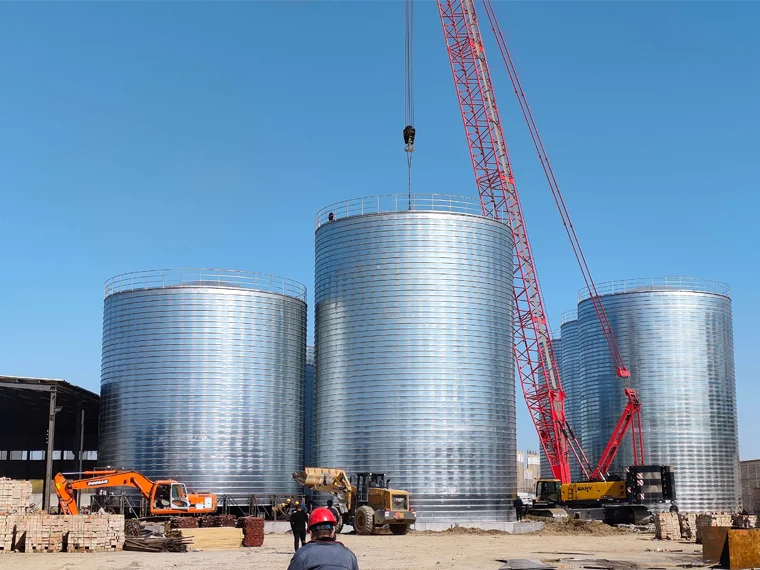
Spiral-folded technology uses specialized equipment to continuously interlock and roll steel sheets into a silo shape, resulting in a body with no longitudinal welds and excellent overall sealing. This process offers fast construction (a single silo can be completed in days) and high material utilization. However, the silo diameter is limited by the width of the steel coil (typically ≤15 meters), and any future capacity increase requires rebuilding rather than expansion. This type is best suited for long-term grain storage or constant-temperature storage of industrial raw materials where airtightness is critical.
Welded Silos: High Strength and Customization
Welded silos are constructed using on-site assembly and welding, allowing for any shape and ultra-large capacities (single silos can reach tens of thousands of cubic meters). They offer the highest structural strength, capable of withstanding high lateral pressure and extreme wind loads. Material upgrades, such as using stainless steel or wear-resistant steel, can handle corrosive or high-temperature materials. The downside is that weld quality depends heavily on on-site workmanship, leading to longer construction times and higher inspection costs. These silos are widely used in heavy industries like cement, chemicals, and mining.
Key Takeaways
- Key Data: Over 70% of steel silo failures are attributed to a mismatch between material characteristics and structural design, not material defects.
- Best Practice: Complete a full material property analysis before project tendering and use the results as the core input for technical bid evaluation.
- Watch Out For: Never select materials based solely on a single index like "tensile strength" or "yield point." A comprehensive evaluation of corrosion resistance, abrasion resistance, and weldability is essential.
- Pro Tip: For high-temperature clinker storage, always specify heat-resistant steel or a dedicated insulation layer to prevent structural degradation.
- Bottom Line: The most cost-effective silo is the one that is precisely matched to your material's unique physical and chemical profile.
Operation and Maintenance: The Engineering Key to Extending Silo Life
The long-term performance of a steel silo depends not only on design and construction but also on a scientific operation and maintenance regime. Common issues include "rat-holing" and "bridging" caused by poor discharge, wall thinning from abrasion, localized corrosion from coating failure, and material caking or spoilage from ventilation system malfunction. To address these, a "preventive maintenance" mechanism should be established: regularly inspect wall thickness using ultrasonic testing, clean ventilation ducts, and test the flexibility of discharge valves. For silos storing highly abrasive materials like mineral powder, it is advisable to pre-install wear-resistant liners in high-wear areas and measure the wear rate quarterly.
Furthermore, standardizing operational procedures is equally critical. For example, grain must be cleaned and dried before entering the silo to prevent the introduction of impurities and high-moisture material. Discharge should follow the "first-in, first-out" principle to avoid long-term material stagnation and caking. For industrial powder silos, strict control of the aeration system pressure is necessary to prevent over-fluidization and the risk of dust explosions. A comprehensive operations manual and training program can extend the design life of a steel silo from 10 years to more than 20 years.
Frequently Asked Questions
Q: For grain storage, how significant is the difference in airtightness between spiral-folded silos and welded silos?
A: Spiral-folded silos, due to their continuous interlocking process with no longitudinal welds, generally offer superior airtightness compared to welded silos, especially under low-pressure conditions like nitrogen-filled grain storage. The airtightness of a welded silo is highly dependent on weld quality and the coverage rate of non-destructive testing, such as X-ray inspection. For long-term grain storage projects requiring an oxygen concentration below 2%, a spiral-folded silo is the more reliable choice. However, for ultra-large capacities exceeding 5,000 tons per silo or when storing high-temperature materials, a welded silo remains the only viable option due to its superior strength and customization capabilities.
Q: How can I evaluate whether the anti-corrosion coating on a steel silo will achieve its expected service life?
A: Evaluating coating life requires monitoring three key indicators: dry film thickness (a standard requirement is ≥200 μm), adhesion (pull-off test should show ≥5 MPa), and salt spray resistance (≥1,000 hours). During operation, a coating inspection is recommended every two years, with a focus on areas prone to water accumulation or mechanical wear, such as the silo roof, inlet, and outlet. If blistering, chalking, or rust spots cover more than 5% of the inspected area, immediate local repair is necessary. For corrosive environments like coastal or chemical plant zones, consider using thermally sprayed zinc-aluminum composite coatings or glass flake liners for enhanced protection.
Q: What are the most common causes of bridging or rat-holing in a steel silo, and how can they be prevented?
A: Bridging and rat-holing are primarily caused by material characteristics like high moisture content, fine particle size, or cohesive properties, combined with improper silo geometry or discharge equipment design. Prevention starts with accurate measurement of the material's angle of repose and internal friction angle during the design phase. Using a mass flow hopper design, installing aeration pads, or fitting a vibratory bin activator can significantly improve flow. For existing silos, retrofitting with air cannons or a mechanical agitator can break up arches. Regular cleaning and maintaining low moisture levels in stored materials are also critical operational steps.
Q: How does the choice of steel grade impact the overall cost and lifespan of a welded silo in a cement plant?
A: In a cement plant, the steel grade directly affects both initial investment and long-term durability. Standard carbon steel (e.g., Q235B) is the most cost-effective for storing ordinary cement clinker or fly ash. However, for areas exposed to high-temperature clinker (e.g., >200°C), using a heat-resistant steel like Q345R or a stainless steel grade (e.g., 304 or 316L) is necessary to prevent strength loss and oxidation. While the material cost is 30-50% higher, it can extend the silo's service life by 10-15 years, reducing the lifecycle cost. For highly abrasive raw meal, specifying a wear-resistant steel (e.g., NM400) for the lower cone section can prevent costly wall thinning repairs.
Q: What is the recommended inspection frequency for a bolted silo to ensure joint integrity?
A: For bolted silos, the bolted joints are the most critical points for structural integrity and sealing. A comprehensive inspection should be conducted annually, focusing on torque verification of a representative sample of bolts, especially after the first year of operation. Visual checks for signs of corrosion, deformation, or leakage around the joints should be performed quarterly. If the silo is used for storing fine powders like cement or fly ash, a dust-tight sealant should be inspected and reapplied as needed. Any bolt found to be loose or corroded must be replaced immediately with a new, properly torqued high-strength bolt to prevent progressive joint failure.
Need expert steel silo solutions for your project?
We provide professional design, manufacturing, and installation services for bulk storage and material handling systems worldwide, serving over 200 projects globally. From material analysis to operational training, we deliver a full lifecycle service.
Get a Free Technical Consultation →