


As Africa’s agricultural and construction sectors rapidly expand, the demand for reliable bulk storage infrastructure has surged. The hopper bottom silo, engineered for gravity discharge, extreme weather resilience, and customizable capacity, is becoming the preferred solution for grain and industrial storage across the continent. This article explores the technical adaptations, market strategies, and operational advantages that make these silos a game-changer for African supply chains.
Hopper Bottom Silo Design: Tailored for Africa’s Storage Challenges
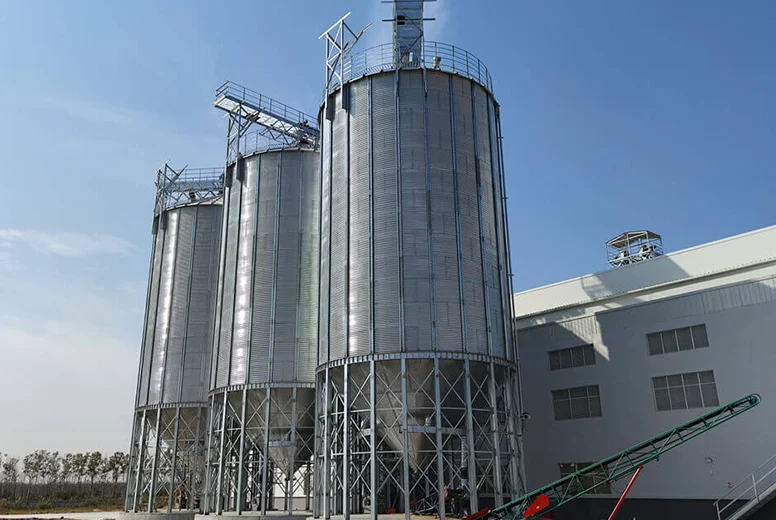
The hopper bottom silo features a conical, sloped base specifically designed for gravity-assisted discharge. Unlike flat-bottom silos that require mechanical sweep augers or screw conveyors, the hopper design relies on the material’s own weight to achieve smooth, complete evacuation. Thi
s dramatically reduces operational complexity and energy consumption — a critical advantage in regions where power supply is unreliable. In Africa’s high-humidity, dusty environments, this design minimizes clogging risks and boosts discharge efficiency.Structurally, the cone angle typically ranges from 45° to 60°, adjusted according to the flow characteristics of the stored material — whether maize, wheat, cassava flour, or cement. This ensures uniform flow and supports batch discharge, perfectly aligning with Africa’s common multi-crop, small-batch, high-turnover storage patterns. The silo body is constructed from high-strength welded steel plate or reinforced concrete, engineered to withstand extreme temperature fluctuations and high wind loads typical of equatorial climates, ensuring long-term structural safety.
Critical Technical Adaptations for Export to Africa
Africa’s diverse climate — from coastal high-salinity fog to inland arid heat — demands specialized upgrades for exported hopper bottom silos. The following three factors directly determine the system’s service life and operational costs.
Corrosion Protection and Climate Adaptation
In coastal regions like Mombasa or Lagos, salt-laden air accelerates metal corrosion. Export-grade hopper bottom silos must feature hot-dip galvanized steel with a minimum coating thickness of 85 microns, supplemented by epoxy-based primers and polyurethane topcoats. For inland arid zones, UV-resistant exterior coatings prevent thermal degradation. Additionally, all bolted connections should use stainless steel fasteners to prevent galvanic corrosion in high-humidity environments, extending the silo’s lifespan to 20+ years.
Foundation and Load-Bearing Design
African soil conditions vary widely, from expansive clays in East Africa to sandy soils in the Sahel. Hopper bottom silos require reinforced concrete ring foundations with proper drainage channels to prevent water pooling at the base. For soft soil sites, deep piles or soil stabilization techniques are essential. The silo’s center of gravity is lower than flat-bottom designs, improving seismic stability, but wind load calculations must account for local gust speeds, which can exceed 120 km/h in cyclone-prone regions like Mozambique.
Discharge System Reliability
The gravity discharge system must be optimized for Africa’s common commodities. For sticky materials like cassava flour or wet maize, a vibrating bin activator or pneumatic aeration pads can be integrated at the hopper throat to prevent bridging. For cement storage, aeration pads and fluidizing cones ensure consistent flow. The discharge gate should be a heavy-duty rack-and-pinion slide gate or a butterfly valve, both easily maintainable with locally available tools. All electrical components must be IP65-rated to withstand dust ingress.
Key Takeaways
- Key Data: Cone angles between 45° and 60° optimize gravity flow for most African crops and industrial powders.
- Best Practice: Specify hot-dip galvanized steel (85-micron min) plus epoxy-polyurethane coating for coastal installations.
- Watch Out For: Underestimating wind loads in cyclone-prone regions — always use local meteorological data for structural calculations.
- Pro Tip: Integrate pneumatic aeration pads for sticky materials like cassava flour to prevent bridging and ensure complete discharge.
- Bottom Line: A properly adapted hopper bottom silo reduces energy consumption by up to 40% compared to flat-bottom designs with sweep augers.
Market Strategy: Why Hopper Bottom Silos Are Winning in Africa
The hopper bottom silo’s market penetration in Africa is accelerating due to three structural advantages. First, its gravity discharge eliminates the need for electrical sweep systems, making it viable for off-grid farms and remote grain collection centers. Second, the modular bolted design allows for rapid on-site assembly without heavy cranes, reducing installation costs by up to 30% compared to welded silos. Third, the conical base allows for complete cleanout between batches, preventing cross-contamination — a critical requirement for multi-crop storage in African cooperatives.
Exporters targeting Africa must also consider local logistics. Flat-packed silo components reduce shipping volume by 60% compared to pre-assembled units, lowering freight costs from China or Europe. On-site training for local technicians in welding, bolting, and maintenance is essential for long-term customer satisfaction. Providing spare parts kits with common wear items — such as gate seals, aeration pads, and fasteners — ensures operational continuity in regions with limited supply chains.
Frequently Asked Questions
Q: How does the hopper bottom silo handle high-moisture grains common in tropical African climates?
A: The hopper bottom design inherently reduces moisture retention through its steep cone angle (typically 55°–60°), which prevents flat-bottom pooling. For high-moisture maize or paddy rice, we recommend integrating aeration ducts at the hopper base and sidewalls, connected to a low-RPM fan. This system can reduce moisture content by 2–3% within 48 hours without mechanical turning. Additionally, the silo’s smooth interior walls — free of ledges or dead spots — minimize condensation pockets. For extremely wet conditions (above 18% moisture), a pre-drying step before silo loading is advised to prevent mold growth.
Q: What foundation preparation is needed for installing a hopper bottom silo on soft laterite soils in West Africa?
A: Soft laterite soils require a reinforced concrete ring foundation with a minimum width of 1.2 meters and depth of 0.8 meters, depending on silo capacity. For capacities above 500 tons, we recommend soil compaction testing to achieve a bearing capacity of at least 150 kPa. In areas with high water tables, install a gravel drainage layer (300 mm thick) beneath the foundation to prevent capillary rise. The silo’s central discharge pit must be waterproofed with a bentonite membrane or PVC liner. For very soft soils, deep piles (8–12 meters) or a raft foundation may be necessary — always engage a local geotechnical engineer for site-specific analysis.
Q: Can a hopper bottom silo be used for both grain and cement storage on the same site?
A: Yes, but with careful design modifications. For grain storage, the cone angle should be 45°–50° with a smooth stainless steel or food-grade epoxy lining. For cement storage, the cone angle must be steeper at 60°–70° with aeration pads to fluidize the powder. A single silo cannot serve both purposes simultaneously without thorough cleaning between uses. However, a multi-silo layout with dedicated hopper bottom silos for each material is highly practical. We recommend color-coded discharge gates and separate aeration systems to prevent cross-contamination. The foundation must be designed for the higher density of cement (1.4–1.6 t/m³) versus grain (0.7–0.8 t/m³).
Q: What is the typical lead time for exporting a hopper bottom silo to an African port like Mombasa or Durban?
A: For a standard bolted hopper bottom silo (100–500 ton capacity), the typical lead time is 8–12 weeks from order confirmation. This includes 4 weeks for engineering and material procurement, 4 weeks for fabrication and quality inspection, and 2–4 weeks for sea freight from China or Europe to East or Southern Africa. We recommend ordering 16 weeks in advance to allow for customs clearance, inland transport, and site preparation. Flat-packed components reduce shipping time by 30% compared to pre-assembled units. Always specify FOB or CIF terms clearly and include a spare parts kit for the first year of operation.
Q: How does the hopper bottom silo compare to a flat-bottom silo for smallholder cooperatives in East Africa?
A: For smallholder cooperatives storing 50–200 tons of maize or beans, the hopper bottom silo is significantly more cost-effective. It eliminates the need for a sweep auger motor (saving $3,000–$5,000 upfront) and reduces electricity consumption by 40–60%. The gravity discharge also allows for manual loading into bags or trucks without conveyor belts, ideal for sites without grid power. However, flat-bottom silos have a lower height profile, which may be preferred in areas with height restrictions. For most East African cooperatives, the hopper bottom’s lower operational cost and simpler maintenance outweigh the slightly higher initial fabrication cost.
Need expert hopper bottom silo solutions for your African project?
We provide professional design, manufacturing, and installation services for bulk storage and material handling systems worldwide. Our team specializes in climate-adapted silos for grain, cement, and industrial powders, with proven installations across 15 African countries.
Get a Free Technical Consultation →