


Choosing the right grain silo is a critical investment that protects your harvest from market volatility and quality degradation. This comprehensive guide compares steel, concrete, spiral, and bolted silos across key dimensions like capacity planning, material durability, ventilation systems, and automation, empowering you to make a data-driven decision for long-term farm profitability.
Precision Capacity Planning: From Annual Yields to Scalable Growth
The first step in selecting a grain silo is a rigorous analysis of current and projected storage needs. We recommend basing your calculations on the average annual yield over the past 3–5 years, then adding a 10%–15% buffer for future expansion. This conservative approach accommodates both yield increases from improved agronomy and shifts in crop rotation—for example, switching from corn to soybeans changes bulk density and storage requirements significantly.
A proven industry best practice is the “split-configuration” strategy. For a farm producing approximately 75,000 bushels of corn annually, instead of building one massive 75,000-bushel silo, consider installing two 30,000-bushel units. This configuration reduces the risk of total loss from a single silo failure by roughly 50% and provides operational flexibility to segregate grain by quality, variety, or moisture content. When calculating net usable capacity, always deduct the volume occupied by ventilation ducts, manholes, temperature cables, and headspace. Modular designs—such as corrugated steel bolted silos—are increasingly popular because they allow phased investment: start with 2–3 units, then expand by adding rings or connecting walkways as your operation grows, avoiding the financial strain of a single, oversized capital expenditure.
Material and Structural Showdown: Steel Silos vs. Concrete Silos
Steel and concrete silos dominate the grain storage market, but they differ markedly in thermal performance, airtightness, and lifecycle costs. Steel silos—especially those made from hot-dip galvanized corrugated panels—offer fast construction timelines, lower upfront costs, and the ability to relocate or modify the structure. However, their high thermal conductivity makes them more sensitive to temperature fluctuations, requiring robust active ventilation systems to prevent condensation. In contrast, concrete silos excel in long-term storage (over 12 months) and extreme climates due to their superior thermal inertia and structural rigidity. The trade-off is longer construction periods, higher initial investment, and the near impossibility of dismantling or moving the structure.
Spiral Silos: Rapid Deployment for Industrial-Scale Operations
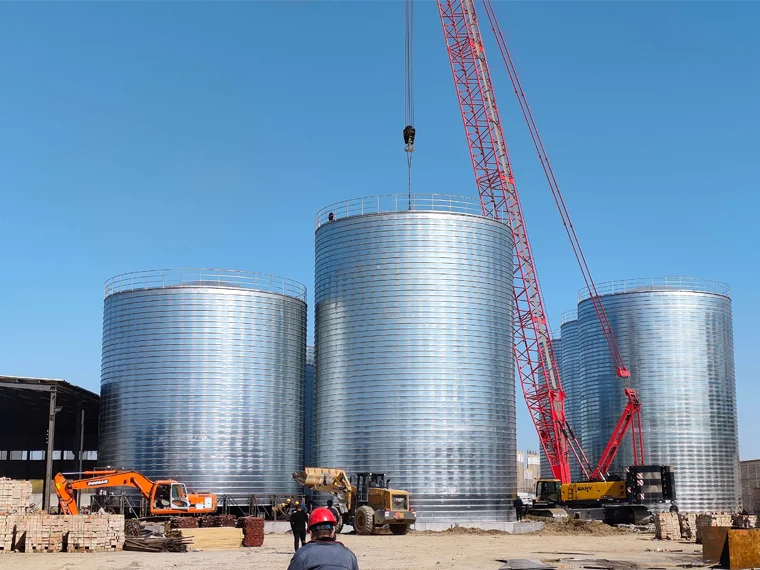
Spiral silos are manufactured using a continuous roll-forming and interlocking seam process—no bolts or welds—resulting in exceptional airtightness. This makes them ideal for operations requiring fumigation or nitrogen-controlled atmospheres. Construction speeds can reach 5–10 meters of height per day, making spiral silos a go-to solution for emergency capacity expansion or seasonal construction windows. However, once erected, modifying a spiral silo is difficult and expensive. They also demand extremely level, high-bearing-capacity foundations, which can increase site preparation costs.
Bolted Silos: The Global Standard for Flexibility and Standardization
Bolted silos are assembled from standardized galvanized steel sheets connected by high-strength bolts. They are the most widely used silo type worldwide due to their interchangeable parts, ease of transport, and capacity adjustability (by adding or removing rings). The main vulnerability is long-term airtightness, which depends on installation precision and gasket aging. We recommend a seal integrity inspection every 3–5 years, especially for operations storing high-value or fumigated grains.
Key Takeaways
- Key Data: A split-configuration strategy (e.g., two 30,000-bushel silos instead of one 60,000-bushel silo) can reduce the risk of total loss from a single equipment failure by approximately 50% while improving inventory turnover flexibility.
- Best Practice: When planning, reserve 10%–15% extra capacity for future growth and prioritize modular steel silo designs that allow low-cost expansion via additional rings or connecting channels.
- Watch Out For: Never overlook the net space consumed by ventilation systems and temperature cables. For long-term storage (>12 months), concrete silos’ thermal inertia provides a decisive advantage over steel silos and is the more reliable choice.
- Pro Tip: For steel silos in hot climates, install roof insulation and reflective coatings to reduce solar-driven temperature gradients inside the silo, minimizing condensation risk.
- Bottom Line: Your silo choice should balance initial cost, operational flexibility, and the specific climate and storage duration of your operation—there is no one-size-fits-all solution.
Ventilation and Temperature Control: The Lifeline of Grain Quality
Regardless of silo type, the ventilation system design is the single most critical factor determining grain storage life. The core principle is that “unit airflow” must match the local climate conditions. In hot, humid regions, we recommend a minimum airflow rate of 0.1 m³/min per tonne (cubic meters per minute per tonne), combined with cone or full-cone aeration floors to ensure dead-zone-free air distribution. Modern automated temperature control systems have evolved from simple monitoring to “predictive intervention”: sensors at multiple depths and humidity probes can automatically activate fans to remove moisture before the dew point is reached. For steel silo owners, installing roof insulation and reflective coatings is strongly advised to reduce solar radiation-induced temperature gradients, which are a primary cause of condensation and spoilage.
Frequently Asked Questions
Q: In a high-humidity region with over 1,200 mm of annual rainfall, which is more reliable—a steel silo or a concrete silo?
A: In high-humidity environments, concrete silos outperform steel silos for long-term storage (over 6 months) due to their low thermal conductivity and thick walls, which effectively suppress condensation on the inner wall surface. However, a steel silo equipped with high-performance insulation (such as polyurethane spray or rock wool sandwich panels) and a forced ventilation system can achieve satisfactory results, typically at a 30%–40% lower construction cost. The critical factor regardless of material is ensuring a flawless foundation moisture barrier and proper drainage design for the aeration ducts at the silo base—otherwise, even the best silo body cannot prevent bottom-layer mold.
Q: How do I decide between a spiral silo and a bolted silo for my farm?
A: The decision hinges on your weighting of “airtightness” versus “future flexibility.” If you primarily store conventional crops like corn or wheat and have no plans to change capacity or relocate within the next three years, a spiral silo’s seamless structure maintains more stable fumigant concentrations during pest control, delivering significantly better insect eradication than bolted silos. Conversely, if you need to frequently adjust storage zones or if your project is in a remote area where transporting large components is difficult, a bolted silo’s standardized flat panels are easier to ship and assemble on-site. Add
itionally, individual damaged parts in a bolted silo can be replaced directly, while local damage to a spiral silo often requires a specialized team for on-site repair, which is more costly.Q: What is the recommended ventilation airflow rate for grain stored in a tropical climate, and why is it important?
A: In tropical climates with high ambient temperatures and humidity, we recommend a minimum ventilation rate of 0.1 m³/min per tonne. This airflow rate is critical because it ensures that aeration can effectively remove heat and moisture from the grain mass before condensation forms on the silo walls or within the grain. Inadequate airflow leads to moisture migration, which creates localized wet spots that promote mold growth and insect infestation, potentially ruining entire batches of grain. For best results, combine this airflow rate with cone or full-cone aeration floors and automated fan controls triggered by temperature and humidity sensors.
Q: Can I expand my bolted silo capacity later, and what are the typical costs involved?
A: Yes, bolted silos are designed for modular expansion. You can increase capacity by adding one or more additional rings (courses) to the top of the existing silo, which increases the overall height. The cost typically ranges from 15% to 25% of the original silo price per additional ring, depending on the silo diameter and the number of rings added. It is essential to verify that your existing foundation and anchor bolts can support the increased load before proceeding. We recommend consulting with a structural engineer to ensure the expanded silo meets all safety and load-bearing requirements.
Q: What is the typical lifespan of a hot-dip galvanized steel grain silo, and how can I maximize it?
A: A well-maintained hot-dip galvanized steel silo can last 25 to 40 years, depending on environmental conditions. To maximize lifespan, implement a regular inspection schedule: check for signs of corrosion (especially at bolted joints and near the base), ensure gaskets remain intact to maintain airtightness, and repaint or apply protective coatings as needed. In coastal or industrial areas with high salt or chemical exposure, more frequent inspections and protective measures are necessary. Proper foundation drainage and avoiding prolonged exposure to standing water are also critical to prevent accelerated corrosion at the silo base.
Q: How does the choice of silo affect my grain drying and aeration strategy?
A: The silo type directly influences your drying and aeration approach. Steel silos, with their higher thermal conductivity, require more active aeration to manage temperature gradients and prevent condensation, especially during seasonal transitions. Concrete silos, due to their thermal mass, buffer temperature changes more effectively, reducing the frequency of aeration cycles needed for long-term storage. However, concrete silos may require longer aeration periods to cool the grain mass initially. For both types, the key is to match the aeration fan capacity and control system to the specific silo’s thermal characteristics and your local climate. Automated systems that integrate temperature and humidity sensors are highly recommended for either silo type to optimize energy use and grain quality.
Need expert manxingsilo solutions for your grain storage project?
We provide professional design, manufacturing, and installation services for bulk storage and material handling systems worldwide. Our team can help you select the optimal silo type, size, and configuration for your specific operational needs and climate conditions.
Get a Free Technical Consultation →