


Grain storage decisions directly impact 15-20% of a farm’s annual profit margin. This practical guide, built on 15 years of industry expertise, provides a complete framework for capacity planning, silo type selection, and budget management to help you avoid costly mistakes and optimize your on-farm storage investment.
Grain Silo Capacity Planning: From Harvest Data to Usable Storage
Many farmers make the critical error of basing their silo purchase on a single season’s yield. This often leads to capacity shortfalls the very next year. A professional approach requires analyzing the average annual yield over the past five years and then adding a 15-20% buffer. This buffer accounts for crop rotation adjustments, yield increases from improved seed varieties, and the strategic need to hold grain for better market prices. For example, a farm with an average annual harvest of 50,000 bushels should plan for a total silo system capacity of 60,000 to 65,000 bushels.
Accurate capacity conversion is also crucial due to varying grain densities. Corn requires approximately 1.25 cubic feet per bushel, while wheat, with its lower test weight, needs about 1.5 cubic feet per bushel. A silo designed for one grain type will hold a different weight of another. Furthermore, a multi-bin strategy—using 3 to 5 medium-sized silos instead of one giant unit—offers superior flexibility. While the per-bin construction cost may be slightly higher, this approach allows for segregation by quality, moisture content, or variety, providing a more profitable and flexible marketing strategy during price fluctuations.
Comparing Silo Types: Spiral, Welded, and Bolted Steel Grain Bins
The three main engineering solutions for modern grain storage are spiral-formed (corrugated spiral), welded steel, and bolted (assembled) corrugated silos. Eac
h offers distinct advantages depending on your storage goals, budget, and site conditions. Spiral silos are renowned for their airtightness, welded silos for their structural strength, and bolted silos for their installation speed and portability.The Airtight Advantage of Spiral-Formed Grain Silos
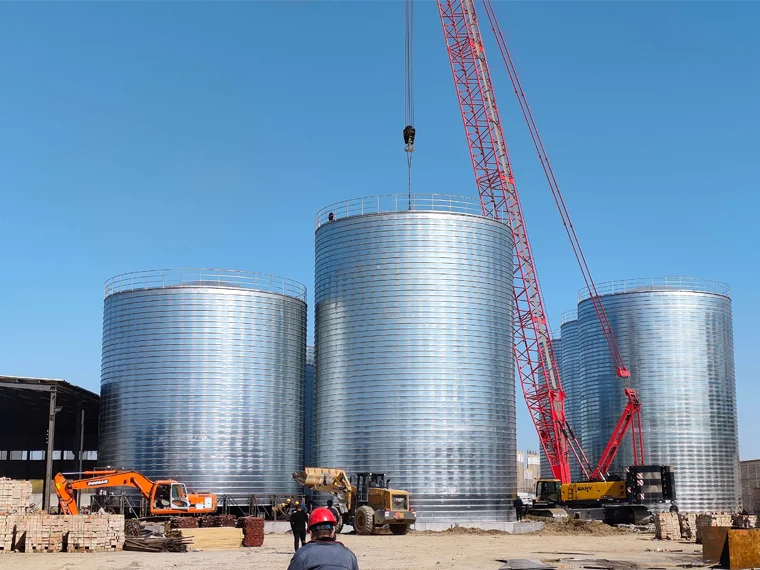
Spiral-formed silos are manufactured using a continuous spiral-rolling process from double-sided galvanized steel sheets. This creates a seamless body with no longitudinal welds, achieving a national Grade 1 standard for airtightness. The smooth interior walls minimize grain bridging and condensation, making them exceptionally well-suited for short-term storage of high-moisture corn or paddy rice where effective fumigation is critical.
Bolted Silos: Flexibility and Cost Control for Expanding Farms
Bolted silos are constructed from standard corrugated panels connected with bolts. Their primary advantage is modularity; they can be disassembled and relocated, making them ideal for farms on leased land or those planning phased expansions. The initial investment is typically 10-15% lower than a comparable spiral silo. However, long-term owners must be diligent about sealing and maintaining the bolted joints to prevent air and moisture infiltration.
Key Takeaways
- Key Data: Adding a 15-20% capacity buffer can prevent forced low-price sales due to unexpected yield increases. At current grain prices, this can recover $3,000 to $5,000 in potential revenue per 10,000 bushels of storage.
- Best Practice: Implement a "main silo + satellite silo" layout. Use the main silo for long-term storage and 2-3 smaller satellite units for grain turnover or segregating different crop varieties.
- Watch Out For: Never order a silo by "bushels" alone. Always provide the specific grain density (e.g., 45 lbs/bu for corn vs. 60 lbs/bu for wheat). Failure to do so can lead to a 10-20% error in actual usable capacity.
- Pro Tip: A multi-bin system (3-5 smaller silos) offers better marketing flexibility than one large silo, allowing you to sell different grain lots when prices are most favorable.
- Bottom Line: Your silo purchase is a long-term investment. Pri oritize airtightness for quality preservation, plan for a 20% capacity buffer, and budget for the total installed cost, not just the silo price tag.
Farm Budget Management: Total Cost of Ownership and Hidden Expenses
A common and costly mistake is focusing solely on the initial purchase price of the silo. The total project cost includes the foundation, aeration system, temperature monitoring cables, grain handling equipment (legs and conveyors), and ongoing maintenance like recoating. A silo with a $50,000 price tag can easily require an additional 30-50% in site preparation and installation fees. More importantly, operational energy costs vary significantly. A silo with poor airtightness requires more frequent aeration to control grain temperature, leading to thousands of dollars in extra electricity costs annually. It is wise to set aside a 15% contingency fund in your budget for unexpected site conditions or new environmental compliance requirements.
Frequently Asked Questions
Q: Which type of silo—spiral or welded—is better for high-humidity climates?
A: Spiral-formed silos are the superior choice for high-humidity environments. Their continuous seam construction creates a seamless body with far superior airtightness compared to welded silos, whose weld seams can develop micro-cracks over time due to thermal expansion, contraction, and corrosion. This airtight seal is critical for preventing external moisture ingress and maintaining effective fumigation gas concentrations, which is vital for mold prevention. However, be aware that the galvanized coating on a spiral silo may require an additional protective layer in highly acidic or coastal salt-spray environments.
Q: How can I properly evaluate the construction quality of a grain silo supplier?
A: Evaluate suppliers on three critical points. First, verify they have their own in-house structural design qualifications and dedicated installation crews, rather than acting as a trading company that subcontracts the work. Second, request references for at least three projects of similar capacity in your region. Visit these sites to inspect for silo settlement, the condition of sealant gaskets, and overall build quality. Third, ask for detailed warranty terms, specifically whether they cover grain spoilage caused by a failure to meet airtightness standards. Industry data shows that silos installed by professional teams have a less than 2% chance of major failure in the first five years, compared to an 8-12% failure rate for installations by non-specialist crews.
Q: What is the most common mistake farmers make when planning grain storage capacity?
A: The most frequent error is planning capacity based on a single, recent harvest year rather than a multi-year average. This leads to immediate capacity shortages when a bumper crop occurs. A second major mistake is ignoring the difference in test weight between grains. Ordering a silo for "50,000 bushels of wheat" when you intend to store corn will result in significant underutilization of volume, as wheat is less dense. Always provide the specific grain type and its standard density (e.g., lbs/bushel) to your silo manufacturer to ensure the design matches your actual storage needs.
Q: Are bolted silos a good long-term investment for a permanent farm site?
A: While bolted silos offer a lower initial cost and the advantage of being relocatable, they require more diligent long-term maintenance than spiral or welded silos. The primary concern is the integrity of the bolted joints and seals, which can degrade over time, leading to air and moisture leaks. For a permanent site, a spiral-formed silo is often a better long-term investment due to its superior airtightness and lower maintenance requirements. Bolted silos are best suited for temporary sites, leased land, or operations that anticipate significant future expansion and may need to reconfigure their storage layout.
Q: How much does the foundation and installation typically add to the total cost of a grain silo?
A: The cost of site preparation, foundation work, and installation can add a significant 30% to 50% to the purchase price of the silo itself. This includes concrete for the ring foundation, grading, electrical work for aeration controls, and crane rental for assembly. For a silo priced at $50,000, you should budget an additional $15,000 to $25,000 for these essential components. Failing to budget for this total installed cost is a primary reason for project delays and financial strain.
Need expert grain storage solutions for your farm?
We provide professional design, manufacturing, and installation services for bulk storage and material handling systems worldwide. Our 15 years of experience ensure every project meets the highest EEAT standards for quality and reliability.
Get a Free Technical Consultation →