


For cement plants and concrete batching stations, reliable storage is non-negotiable. The hopper bottom silo, with its gravity discharge design and superior sealing, directly addresses the industry’s biggest pain points: bridging, moisture damage, and dust pollution. This guide provides a technical deep-dive into how this silo type can boost your operational efficiency by over 30% while cutting maintenance costs in half.
What is a Hopper Bottom Silo for Cement Storage?
A hopper bottom silo is a cylindrical storage vessel with a conical or sloped bottom, specifically engineered for the efficient storage and discharge of powdered and granular materials like cement. Unlike flat-bottom silos, which require mechanical sweep augers or air cannons to move material to the outlet, the hopper bottom uses gravity. The steeply angled cone—typically between 60° and 70°—guides the cement towards the central outlet, ensuring a “first-in, first-out” flow pattern. This design virtually eliminates common flow problems such as bridging (where material forms an arch) and rat-holing (where material only flows through a central channel), which can cripple production schedules.
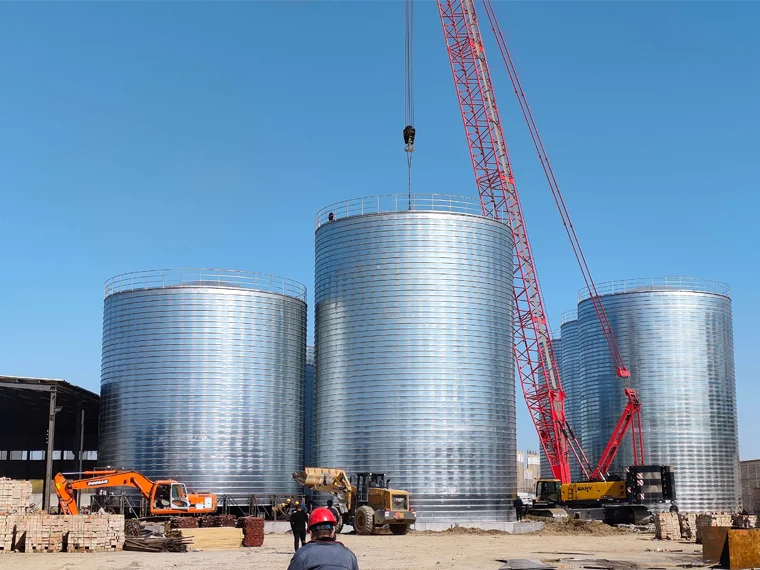
In the cement industry, these silos are typically constructed from corrosion-resistant steel plate or high-strength concrete, with interior walls treated to withstand the abrasive nature of cement powder. Capacities range from small batch storage units of 50 tons to massive industrial installations holding tens of thousands of tons. Modern hopper bottom silos utilize modular bolted or welded assembly, allowing for rapid on-site installation and future expansion as your storage needs grow.
Solving the Three Critical Pain Points of Cement Storage
Cement storage presents three major challenges: discharge blockages, quality degradation from moisture, and fugitive dust emissions. The hopper bottom silo is engineered to solve all three simultaneously.
1. Gravity Discharge: Eliminating Blockages for Continuous Operation
The primary advantage of a hopper bottom silo is its reliance on gravity. The 60° to 70° cone angle is carefully calculated to exceed the angle of repose of cement powder, ensuring a smooth, consistent flow without the need for vibrators, air hammers, or mechanical agitators. This is critical in a concrete batching plant where a discharge interruption can lead to inaccurate mix designs and costly downtime. Field data confirms that hopper bottom silos improve discharge efficiency by over 30% compared to flat-bottom designs, and material residue is typically less than 1% of the total stored volume.
2. Hermetic Sealing: Protecting Cement Activity and Quality
Cement is highly hygroscopic; exposure to moisture triggers a hydration reaction that leads to caking and a loss of strength. Hopper bottom silos feature a fully welded, airtight shell. This is complemented by a sealed top-mounted pressure/vacuum relief valve and a sealed bottom discharge valve, which together prevent external humid air from entering the silo. For extreme environments, an integrated dehumidification system can maintain internal relative humidity below 40%, ensuring the cement remains free-flowing and retains its compressive strength, even during long-term storage.
3. Environmental Dust Control: Meeting Strict Emission Standards
Dust generation during cement loading and unloading is a major environmental and regulatory concern. Hopper bottom silos can be equipped with high-efficiency top-mounted pulse-jet cartridge or baghouse dust collectors. These systems can reduce particulate matter emissions to below 10 mg/Nm³, compliant with international standards such as China’s GB 16297-1996 and the EU’s Industrial Emissions Directive (2010/75/EU). Furthermore, integrated pressure relief devices and level sensors prevent over-pressurization, eliminating the risk of a catastrophic silo failure.
Key Takeaways
- Key Data: Hopper bottom silos achieve a 30%+ higher discharge efficiency and less than 1% material residue compared to flat-bottom designs.
- Best Practice: Specify a cone angle of 60° to 70° with abrasion-resistant liners to extend the silo’s service life by 5 to 8 years.
- Watch Out For: Cement should not be stored for more than 3 months without rotation; implement a “first-in, first-out” inventory management system.
- Pro Tip: Always equip your hopper bottom silo with an explosion vent and a continuous level indicator to ensure safety and operational visibility.
- Bottom Line: While the initial investment is 15-20% higher than a flat-bottom silo, the total cost of ownership is significantly lower due to reduced maintenance and zero energy consumption for discharge.
Typical Applications in the Cement Industry
The modular and customizable nature of hopper bottom silos makes them ideal for every node in the cement supply chain. In cement grinding stations, they serve as finished product silos, ensuring continuous dispatch for bulk tanker loading. In ready-mix concrete plants, they function as precise weigh hoppers for cement and other binders, guaranteeing mix consistency. For precast concrete factories, they integrate seamlessly with pneumatic conveying systems for automated material feeding. They are also increasingly used in cement kiln co-processing projects to store alternative fuels like biomass pellets, where the anti-bridging design handles non-homogeneous materials effectively.
From an economic standpoint, the total cost of ownership for a hopper bottom silo is lower than a flat-bottom silo. The initial premium (15-20%) is quickly offset by a 50% reduction in maintenance frequency, zero energy costs for mechanical discharge equipment, and significantly less material waste. For a cement plant with an annual output of 1 million tons, switching to hopper bottom silos can save approximately 200,000 RMB (or equivalent in local currency) per year in operational expenses.
Frequently Asked Questions
Q: What is the core difference between a hopper bottom silo and a flat-bottom silo for cement storage?
A: The core difference lies in the discharge mechanism and space utilization. A hopper bottom silo relies on gravity to achieve a “first-in, first-out” flow pattern, preventing cement from caking due to long-term static storage and eliminating the need for clean-out equipment. A flat-bottom silo requires mechanical sweep augers or air cannons for discharge, which creates dead zones where material can stagnate. However, flat-bottom silos offer higher volumetric efficiency (the cone of a hopper silo occupies 15-20% of total volume). The rule of thumb is: choose a hopper bottom silo for high-turnover applications like batching plants; choose a flat-bottom silo with auxiliary discharge for long-term static storage.
Q: How does the hopper bottom silo’s moisture protection system work in high-humidity environments?
A: High humidity, common in monsoon seasons or coastal areas, is a major challenge. The protection system is three-tiered. First, the silo shell is fully welded and coated with an epoxy anti-corrosion layer to block external moisture ingress. Second, the top breather valve is equipped with a desiccant cartridge to filter moisture from air entering during loading/unloading. Third, an internal dew point monitor and heating system can be installed; if humidity exceeds a setpoint (e.g., 60% RH), the heater activates to prevent condensation. For maximum protection, a pneumatic gate with a rubber seal at the discharge outlet prevents moist air from backflowing during unloading. In practice, plants in South China with 1500mm annual rainfall have successfully stored cement for 60 days without quality loss using this system.
Q: What is the typical lifespan of a steel hopper bottom silo for cement, and what factors affect it?
A: A well-maintained steel hopper bottom silo can last 20 to 30 years. The primary factors affecting lifespan are corrosion from moisture and abrasion from the cement flow. Using a thicker steel plate (e.g., 6mm or 8mm for the cone) and applying a high-quality epoxy or polyurethane lining is critical. The cone section, which experiences the most wear, should be fitted with replaceable abrasion-resistant steel liners. Regular inspections of the internal coating and external paint system, along with maintaining the integrity of the seals, are essential for maximizing longevity.
Q: Can a hopper bottom silo handle blended cements or other cementitious materials like fly ash and slag?
A: Yes, absolutely. Hopper bottom silos are highly versatile and are commonly used for fly ash, slag powder, and blended cements. The key is to ensure the cone angle is steep enough for the specific material’s angle of repose. Fly ash, for example, is finer and more cohesive than Portland cement, often requiring a 65° to 70° cone angle. For materials with different flow characteristics, aeration pads can be integrated into the cone to assist discharge. The silo’s sealing and dust collection systems are equally effective for all these materials.
Q: What safety equipment is mandatory for a hopper bottom silo storing cement?
A: Cement dust is combustible, making safety equipment non-negotiable. Mandatory equipment includes: (1) an explosion vent or rupture panel on the silo roof to relieve pressure from a dust explosion. (2) Continuous level indicators (e.g., radar or weight-and-cable type) to prevent overfilling. (3) High and low level alarms in the control system. (4) A pressure/vacuum relief valve to protect the silo structure during pneumatic filling and discharge. (5) Proper grounding and bonding to prevent static electricity buildup. For high-risk environments, a passive or active nitrogen inerting system can also be specified.
Need a professional hopper bottom silo solution for your cement project?
We provide integrated services from design and manufacturing to installation, supporting custom capacities from 50 to 5,000 tons. Our systems come equipped with intelligent level monitoring and high-efficiency dust collection. Over 300 cement companies have chosen our solutions for their reliability and performance.
Get a Free Technical Consultation →