
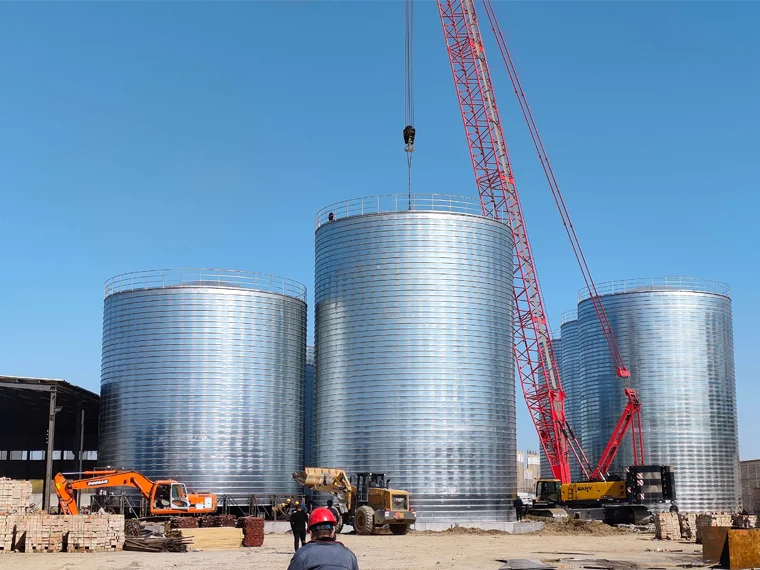
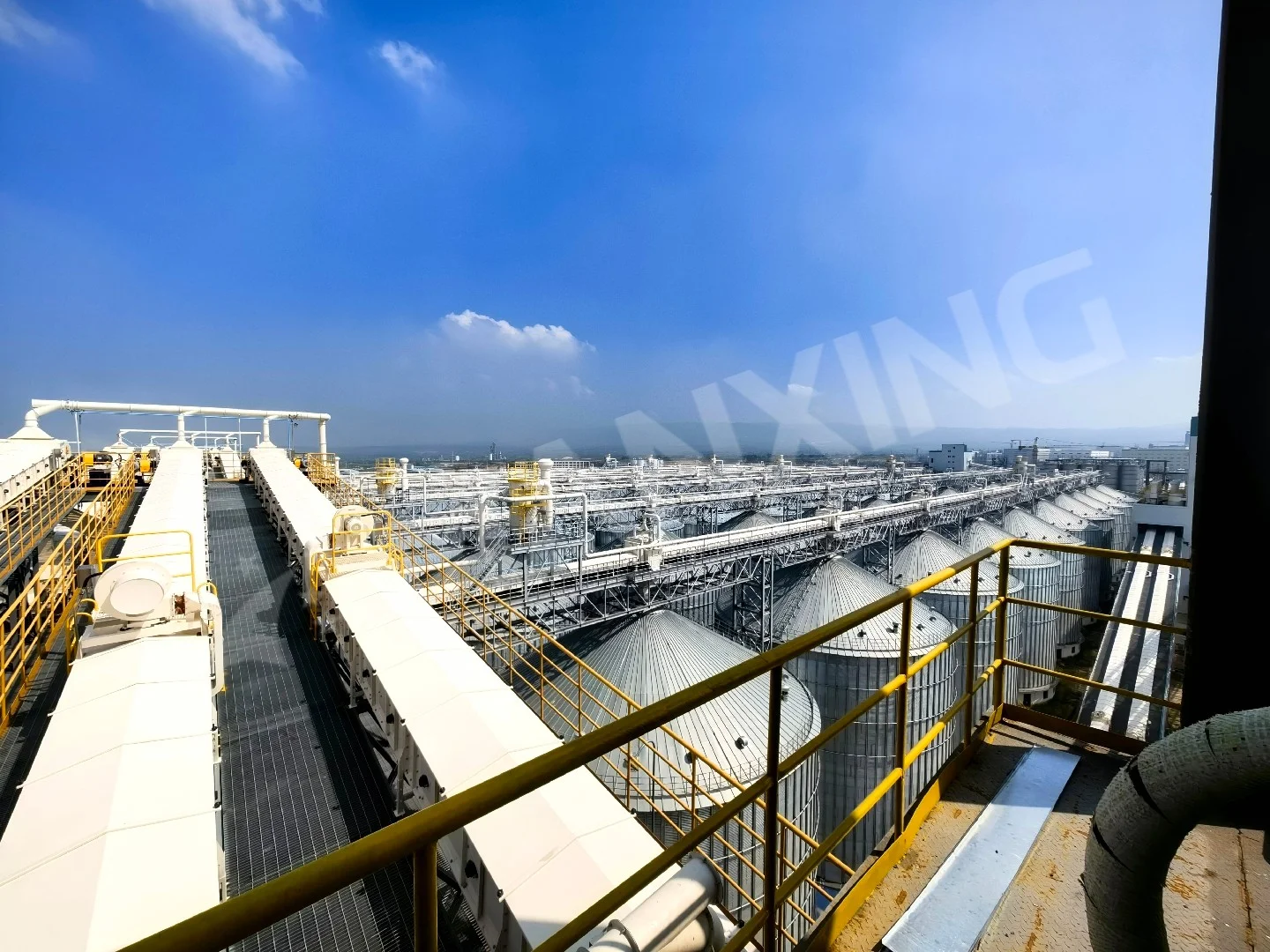


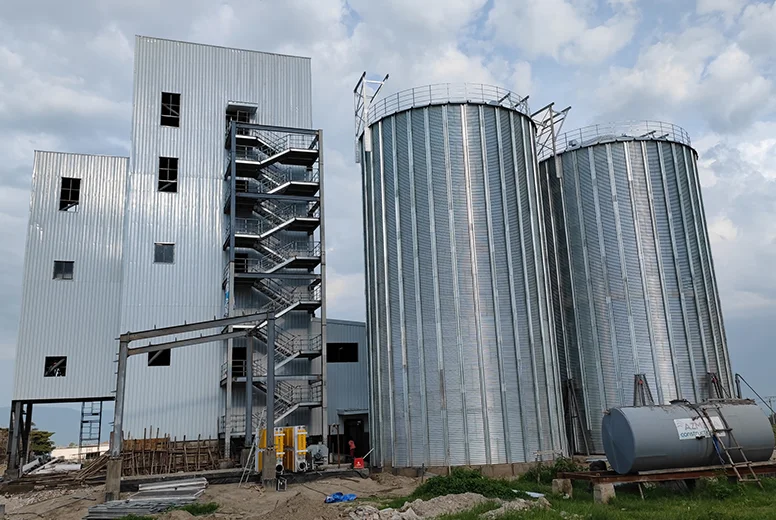
For bulk storage of grains, cement, and chemicals, the flat bottom steel silo offers unmatched structural stability, modular design, and superior sealing. By eliminating the complex support systems of cone-bottom silos, this design reduces civil construction costs by up to 40% while improving discharge efficiency and maintenance accessibility, making it the preferred choice for demanding industrial applications.
Core Structural Characteristics and Engineering Advantages of Flat Bottom Steel Silos
The flat bottom steel silo’s core design combines a cylindrical shell with a flat concrete or steel base. This configuration eliminates the complex support systems of traditional conical bases, resulting in more uniform load distribution. In large-scale storage projects, the flat base effectively mitigates the risk of silo deformation caused by uneven foundation settlement, making it particularly suitable for construction on soft soil or in high-seismic-activity zones. Fur
thermore, the modular wall panels, constructed from high-strength galvanized steel and joined via rolled edges or bolted connections, ensure excellent airtightness while dramatically reducing on-site installation time.From an engineering mechanics perspective, the flat base uniformly transfers vertical loads to the foundation, avoiding the stress concentration points common in cone-bottom designs. This allows flat bottom steel silos to safely store materials with densities up to 1.8 tons per cubic meter—such as cement clinker or mineral powder—without requiring additional reinforcement. Additionally, the smooth interior walls minimize material adhesion, a critical feature for powdery materials with poor flowability.
How to Solve Discharge Efficiency and Material Residue Problems
The primary operational challenge for flat bottom steel silos is material residue in "dead zones." Since the bottom is flat, relying solely on gravity discharge often causes a funnel flow pattern in the central material, leaving peripheral material unable to exit automatically. Modern flat bottom silos integrate several solutions to address this:
Multi-Point Discharge and Pneumatic Sweeping Systems
By installing multiple discharge outlets (typically 3-6) combined with a bottom aeration system, compressed air breaks material arches and fluidizes the material for smooth discharge. This design can reduce residue rates to below 1%, significantly outperforming the 5-8% typical of traditional cone-bottom silos.
Center Cone and Scraper Combination
An inverted center cone is installed on the flat base to guide material toward the central discharge outlet. Paired with a rotating bottom scraper, this system achieves self-cleaning discharge of the entire silo. This solution is particularly suitable for industries with strict residue requirements, such as feed and grain storage.
Key Takeaways
- Key Data: Flat bottom steel silos reduce civil foundation costs by 30%-40% compared to cone-bottom silos, with single-silo capacities exceeding 10,000 tons.
- Best Practice: For poor-flowing powders, prioritize the "pneumatic fluidization + multi-point discharge" combination to ensure discharge efficiency.
- Watch Out For: Moisture-proof design must focus on sealing at the base-to-foundation connection; double-layer sealant strips and epoxy resin coatings are recommended.
- Pro Tip: For high-moisture grain storage, pre-install aeration ducts in the concrete foundation to enable forced ventilation from the bottom up, preventing spoilage.
- Bottom Line: The flat bottom steel silo delivers the best balance of cost-efficiency, structural integrity, and long-term maintainability for large-scale bulk storage.
Cross-Industry Applications and Selection Guide
Flat bottom steel silos demonstrate strong adaptability across diverse sectors. In agriculture, they are widely used for long-term storage of wheat, corn, and soybeans, where excellent sealing inhibits pests and mold, and integrated ventilation systems keep grain moisture within safe limits. In the building materials industry, cement, fly ash, and aggregates are commonly stored in flat bottom silos due to their easy integration with bulk trucks and conveying pipelines. In the chemical sector, for materials like plastic pellets, carbon black, and titanium dioxide, corrosion-resistant coatings and explosion-proof designs are standard features.
Selection requires evaluating three key dimensions: material characteristics (particle size, angle of repose, corrosiveness), discharge frequency (continuous operation vs. batch withdrawal), and site space. Elevated flat bottom silos, with discharge outlets high enough for direct truck loading, suit compact factory sites. In-ground flat bottom silos are ideal for installations requiring weighbridge integration or connection to existing conveyor systems.
Frequently Asked Questions
Q: How can flat bottom steel silos prevent mold at the base when storing high-moisture grain?
A: High-moisture grain storage is a key challenge. Flat bottom silos can be equipped with "aeration ducts" or "aerated floors" for forced ventilation. The specific method involves pre-embedding ventilation pipes in the concrete foundation and using fans to push dry air upward from the bottom, creating through-flow airflow. We also recommend installing a grid of temperature sensors on the silo floor to monitor grain temperature in real time. If a local temperature rise is detected, targeted ventilation or grain transfer can be initiated immediately. For grain with moisture content exceeding 14%, a low-temperature drying system must be used in conjunction.
Q: What are the cost and service life differences between flat bottom steel silos and spiral (Lipp) steel silos?
A: The differences mainly stem from manufacturing processes. Spiral (Lipp) silos use a continuous roll-forming process with steel thickness typically 2-4mm, resulting in 15-20% higher cost. However, they offer excellent airtightness without bolted connections, making them ideal for materials requiring extreme sealing, such as nitrogen-blanketed grain. Flat bottom steel silos typically use bolted or welded connections with steel thicknesses up to 6mm or more, providing higher overall structural strength and a service life exceeding 30 years. In terms of maintenance, the modular design of flat bottom silos allows for easier replacement of individual wall panels, while repairing localized damage in spiral silos is more difficult and costly. Therefore, for long-term stability and ease of maintenance, flat bottom silos offer a clear advantage.
Q: Can flat bottom steel silos be used for storing abrasive materials like cement clinker?
A: Yes, they are well-suited for this application. The high-strength galvanized steel panels, often with thicknesses of 4-6mm, provide excellent abrasion resistance. For particularly abrasive materials, we recommend adding internal wear-resistant liners or applying a hard-facing coating to the lower wall sections. The flat bottom design also simplifies the installation of heavy-duty discharge equipment, such as clinker breakers or vibrating feeders, which are essential for handling such materials.
Q: What is the typical foundation requirement for a large flat bottom steel silo?
A: The foundation is typically a reinforced concrete ring beam or a solid raft slab, designed based on soil bearing capacity and silo load. For silos over 5,000 tons, a geotechnical investigation is mandatory. The flat base distributes the load evenly, so a well-designed concrete slab 300-500mm thick with appropriate steel reinforcement is common. In areas with poor soil, pile foundations may be required. The key is to ensure the foundation is perfectly level and has a smooth, hard surface to accept the silo's bottom ring.
Q: How does the flat bottom design affect the overall height and footprint of the storage system?
A: Compared to a cone-bottom silo of the same volume, a flat bottom silo has a shorter overall height because it does not require the cone section. This can be a significant advantage in areas with height restrictions, such as near airports or in buildings with limited clearance. However, the footprint (diameter) may be slightly larger for the same volume. The flat base also allows for more flexible layout of discharge equipment and conveyor systems underneath, which can optimize the overall plant footprint.
Need expert flat bottom steel silo solutions for your project?
We provide professional design, manufacturing, and installation services for bulk storage and material handling systems worldwide. From site survey and structural design to equipment fabrication and on-site installation, our engineers can tailor the optimal solution for your new project or retrofit.
Get a Free Technical Consultation →