
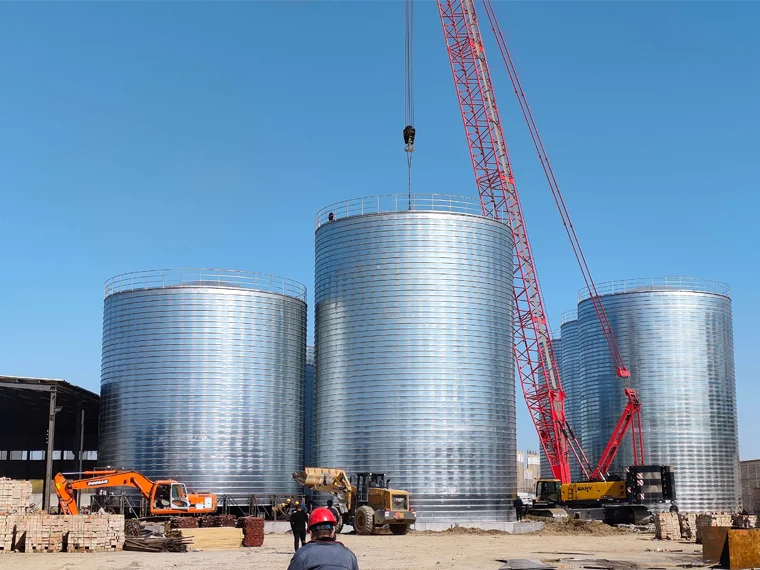
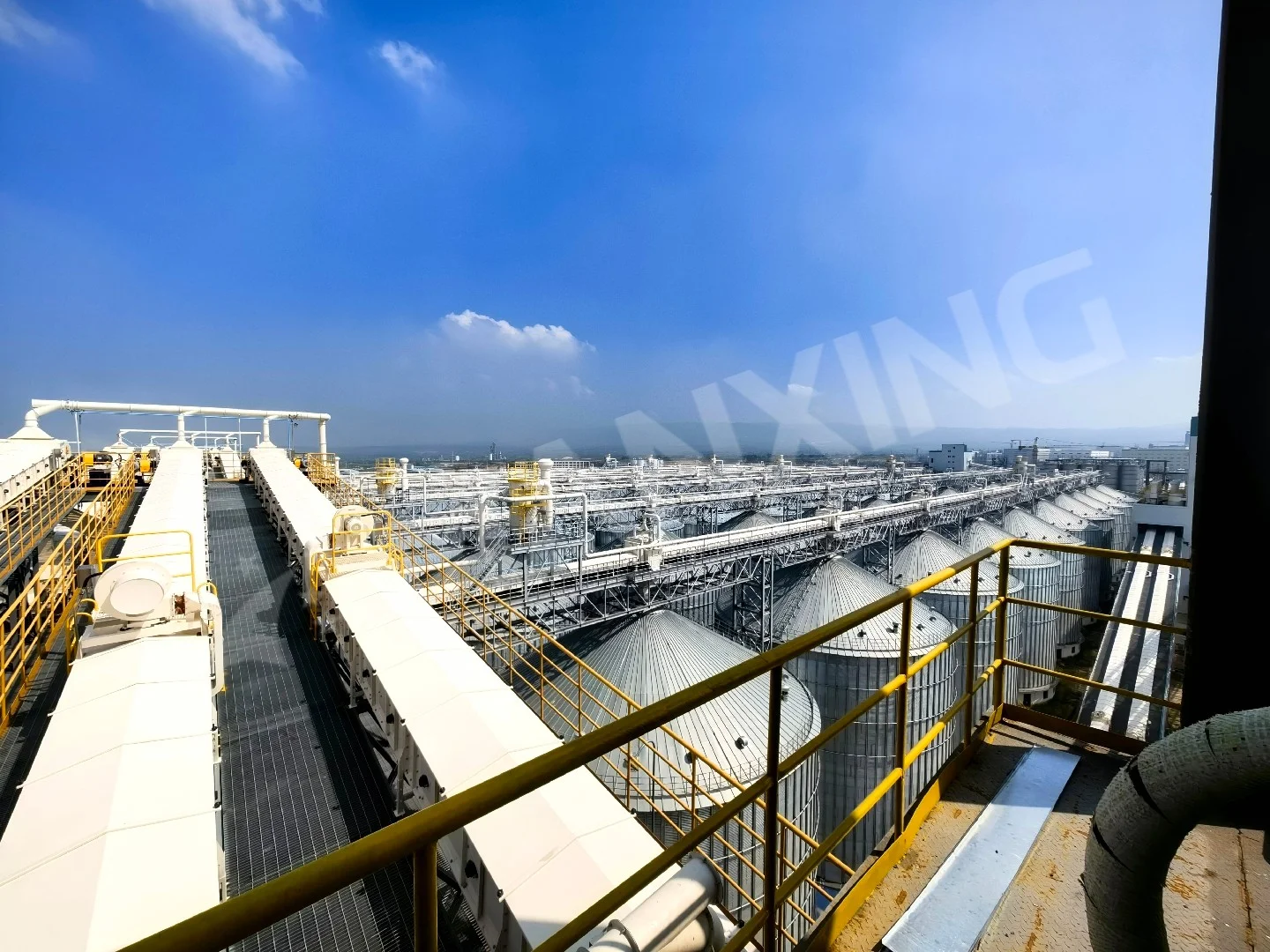


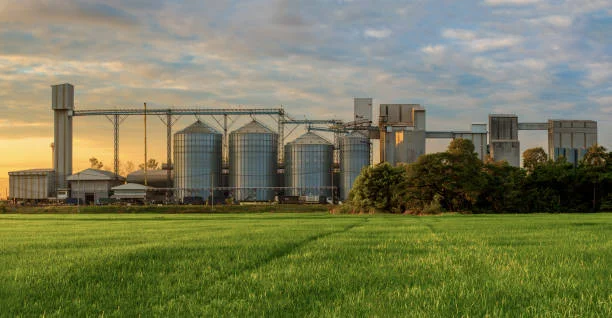
Modern large-scale grain silo design has evolved far beyond simple storage containers into highly engineered agricultural infrastructure. This technical specification guide provides engineers and project decision-makers with a systematic reference for structural loads, material selection, and safety redundancy, ensuring compliance with contemporary industrial standards.
Core Structural Load Parameters for Large Grain Silos
Designing a large grain silo with a capacity of 50,000 tons requires engineers to simultaneously address the combined challenges of static and dynamic loads. According to Janssen's theory of bulk solids pressure, the lateral pressure at the base of a silo can exceed 45 kPa, directly determining wall thickness and stiffener configuration. Specifically, wheat has a unit weight of approximately 800 kg/m³, while corn at standard moisture content weighs about 720 kg/m³; every 1% increase in moisture content alters bulk density by roughly 0.5%, necessitating design considerations for the most unfavorable material combination.
Beyond the self-weight of stored materials, wind loads and seismic loads are critical variables for structural safety. In coastal or high-wind regions, the wind pressure coefficient at the silo top must be increased to 1.8 per code requirements. In seismic zones with intensity 7 or higher (Chinese seismic scale) or equivalent PGA levels, nonlinear time-history analysis is mandatory to ensure the silo does not overturn or experience local buckling during rare earthquake events. Thermal expansion stress is equally non-negligible—for steel silos experiencing diurnal temperature differences exceeding 30°C, axial expansion/contraction can reach 25 mm per 100 meters of height, which must be absorbed through sliding supports or expansion compensators.
Material Selection and Corrosion Protection: From Galvanizing to Composite Coatings
Material specifications directly determine the service life and maintenance costs of a silo. Hot-dip galvanized steel remains the most widely adopted solution globally due to its excellent weather resistance and cost-effectiveness. The standard requires a minimum zinc coating weight of 275 g/m²; in high-humidity or chemically corrosive environments, this specification should be increased to 350 g/m² or more, combined with a sealing topcoat.
Steel Plate Strength and Wall Thickness Design
For large spiral corrugated silos, the commonly used steel grades are Q355B or S355JR, with a minimum yield strength of 355 MPa. Wall thickness decreases in a stepped manner from bottom to top: typically 6–8 mm at the bottom section, 4–6 mm in the middle, and 3–4 mm at the top. Thi
s tapered design conforms to the lateral pressure distribution pattern of bulk materials while reducing steel consumption by approximately 15% to 20%.Durability Requirements for Concrete Silos
Concrete silos offer distinct advantages in impact resistance and thermal insulation. The
design compressive strength grade should not be lower than C40, with a water-to-binder ratio controlled below 0.45, and polypropylene fibers should be added to inhibit early-age shrinkage cracking. For silos storing high-moisture grain (e.g., corn with moisture content exceeding 18%), the inner walls must be finished with waterproof mortar plaster or epoxy coating to prevent moisture penetration that could lead to reinforcement corrosion.Key Takeaways
- Key Data: Base lateral pressure in a 50,000-ton silo exceeds 45 kPa; wall thickness must taper from 8 mm at the bottom to 3 mm at the top per Janssen theory.
- Best Practice: Hot-dip galvanizing coating weight must be no less than 275 g/m²; in corrosive environments, increase to 350 g/m² and apply a sealing topcoat.
- Watch Out For: Ignoring thermal expansion stress is a common cause of fatigue failure in silo connections—reserve 25 mm of compensation per 100 meters of height.
- Pro Tip: Always perform material shear tests and wall friction tests before design to obtain accurate Janssen parameters for the specific grain type.
- Bottom Line: Modern large-scale silo design must integrate structural engineering, material science, and intelligent monitoring to achieve safe, durable, and cost-effective storage.
Safety Redundancy and Intelligent Monitoring Systems
Modern large-scale silo design has shifted from "passive load-bearing" to "active safety." In addition to traditional explosion vents and ventilation systems, an increasing number of projects integrate distributed fiber-optic temperature monitoring and radar level measurement systems. When the temperature in any zone within the silo exceeds a preset threshold (typically 40°C) or when the material level fluctuates abnormally, the system can trigger audible and visual alarms within 30 seconds and automatically activate fans or discharge equipment. Furthermore, Structural Health Monitoring (SHM) systems collect real-time stress, strain, and vibration data, providing a basis for decision-making throughout the silo's lifecycle and reducing the risk of sudden failures by more than 80%.
Frequently Asked Questions
Q: In coastal high-salt-spray areas, is a galvanized coating weight of 350 g/m² sufficient, or is an additional topcoat necessary?
A: In ISO 9223-defined corrosivity categories C4 and above (e.g., within 1 km of the coastline), relying solely on 350 g/m² hot-dip galvanizing is insufficient. A "dual-coating system" is recommended: a hot-dip galvanized base layer (≥350 g/m²) followed by an epoxy zinc-rich or polyurethane sealing topcoat, achieving a total dry film thickness of at least 180 microns. Additionally, all welds and bolted connections must be repaired with cold galvanizing compound to prevent localized accelerated corrosion. Based on field feedback, this approach extends the first major maintenance cycle from 8 years to over 15 years.
Q: How should silo design parameters be adjusted for different stored materials such as wheat, corn, and soybeans?
A: The physical properties of different materials vary significantly and require differentiated design. For example, wheat (bulk density ~800 kg/m³, internal friction angle 28°) versus corn (bulk density ~720 kg/m³, internal friction angle 32°): corn's larger internal friction angle reduces the lateral pressure ratio (k-value) by about 10%, but its poorer flowability requires the dynamic overpressure factor (Cd) during discharge to be increased to 1.3 or higher. Soybeans, with their high oil content and low friction coefficient, tend to create "slip planes" against the silo wall, necessitating anti-slip ribs or stainless steel liners on the interior surface. Material shear tests and wall friction tests must be conducted before design to obtain accurate Janssen parameters.
Q: What is the typical design service life of a large steel grain silo, and what factors most affect longevity?
A: A well-designed and properly maintained large steel grain silo typically has a design service life of 25 to 50 years. The most critical factors affecting longevity are the corrosion protection system and the management of fatigue loads. In C3 corrosivity environments (moderate), a 275 g/m² galvanized coating with regular inspections can last 20–30 years before major recoating is needed. However, fatigue from cyclic filling and emptying, combined with thermal cycling, can cause cracking at welded joints and bolted connections, especially if thermal expansion was not properly accounted for. Regular structural health monitoring and timely recoating of the corrosion protection system are essential to maximizing service life.
Q: What are the key differences between bolted steel silos and spiral corrugated silos for large-scale grain storage?
A: Bolted steel silos offer greater flexibility in diameter and height, making them suitable for very large capacities (e.g., 50,000 tons and above) and sites with limited access, as they can be shipped in flat packs and assembled on-site. They typically require more stringent quality control on bolt torque and sealing to prevent leaks. Spiral corrugated silos, formed from a continuous steel strip, provide superior airtightness and structural continuity, with fewer potential leak points. However, they are generally limited to smaller diameters (typically up to 20–30 meters) and may be more challenging to transport in one piece for very large sizes. For capacities above 30,000 tons, bolted silos are often the more practical choice, provided proper assembly and sealing protocols are followed.
Q: How does the design for storing high-moisture grain (e.g., >18% moisture corn) differ from standard dry grain storage?
A: Storing high-moisture grain introduces several critical design challenges. First, the increased bulk density (up to 10% higher than dry grain) directly increases lateral pressures on the silo walls. Second, the risk of spoilage and mold growth is significantly higher, requiring enhanced aeration systems—often with higher airflow rates (0.1–0.2 m³/min per ton) and more frequent monitoring. Third, the high moisture content accelerates corrosion of steel components, necessitating the more robust corrosion protection system described above (350 g/m² galvanizing plus epoxy topcoat) for steel silos, or waterproof internal linings for concrete silos. Finally, the discharge system must be designed to handle the reduced flowability of wet grain, often requiring larger hopper angles and vibratory aids to prevent bridging or arching.
Need professional large-scale grain silo design solutions for your project?
We provide comprehensive, customized services—from load analysis and material selection to intelligent monitoring systems—ensuring your project meets the latest international standards (e.g., EN 1991-4, ACI 313).
Get Your Free Technical Consultation →