


Moisture control is the single most critical factor in grain and industrial powder storage, directly impacting product quality, safety, and financial loss. A hopper bottom silo integrated with an intelligent moisture management system—combining a gravity-discharge conical design with automated climate control—offers a proven, high-efficiency solution to reduce spoilage and maintain material integrity for agricultural and industrial applications.Related: Custom design concrete silo
rong>The Technical Synergy of Hopper Bottom Silo Design and Active Moisture Control
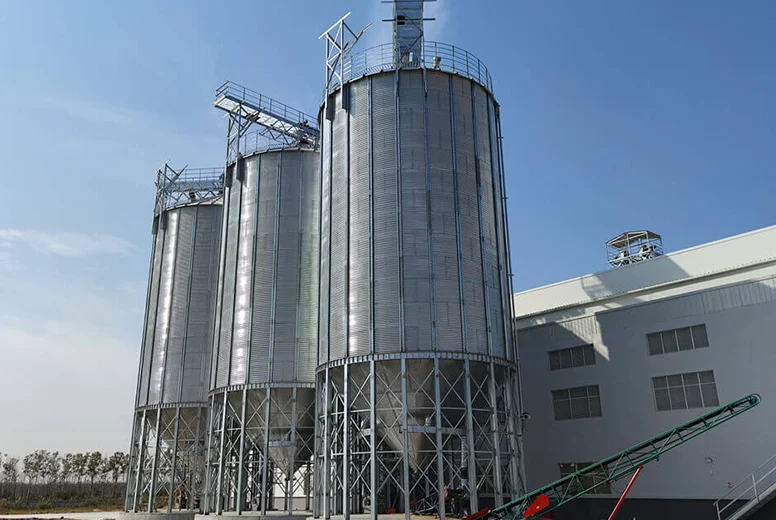
The hopper bottom silo is defined by its funnel-shaped base, which provides a natural advantage for complete discharge by gravity, eliminating the need for mechanical sweepers or manual cleanout. However, this structural benefit alone is insufficient for modern storage challenges. When integrated with active moisture control technology, the hopper bottom silo evolves from a passive container into an intelligent climate regulator.
This system relies on strategically placed humidity and temperature sensors within the silo wall, cone, and ventilation ducts, all linked to a PLC (Programmable Logic Controller). The system continuously monitors dew point temperature and relative humidity, automatically activating ventilation fans or dehumidification units to maintain the moisture content of stored materials within a safe threshold—typically 12% to 14% for grain and below 0.5% for industrial powders like cement. This dual design of structure plus control fundamentally resolves common issues found in flat-bottom silos, such as water pooling at the base and mold growth in dead zones.
Solving the Core Storage Problem: Moisture-Induced Loss and Quality Degradation
Uncontrolled moisture is the invisible killer of stored bulk materials. For grain, when local humidity exceeds 65% or temperature gradients cause condensation, mold reproduction accelerates. This leads to mycotoxin contamination, reduced market grade, and potential rejection by buyers. For industrial powders like cement or fly ash, even trace moisture can cause clumping, hydration reactions, and complete loss of material flowability, rendering the product unusable. The financial impact is severe: a single 3,000-ton grain silo experiencing a 5% moisture-related loss can represent over $75,000 in wasted product at current market prices. An integrated moisture control system in a hopper bottom silo directly addresses these risks by maintaining a stable microclimate throughout the stored mass.
Preventing Condensation at the Cone and Walls
The conical hopper section is particularly vulnerable to condensation because it creates a temperature differential between the cooler silo wall and warmer stored material. Active moisture control systems use targeted ventilation at the cone to equalize temperature and remove humid air before it can condense. This prevents "sweating" on the steel surface, which would otherwise drip back into the material and create localized wet spots that accelerate spoilage.
Automated Response to Environmental Changes
Unlike manual aeration systems that rely on operator judgment, PLC-controlled moisture management responds in real-time to changing weather conditions. When a rainstorm approaches or nighttime temperatures drop, the system can automatically close louvers, seal vents, and activate dehumidifiers to protect stored material. This 24/7 autonomous operation is essential for facilities operating with minimal staff or in regions with unpredictable climates.
Key Takeaways
- Key Data: Safe moisture thresholds are 12-14% for grain and below 0.5% for industrial powders like cement.
- Best Practice: Integrate PLC-controlled humidity and temperature sensors at the silo wall, cone, and ventilation ducts for real-time monitoring and automated response.
- Watch Out For: Condensation at the conical hopper section—this is the most common failure point where moisture damage starts.
- Pro Tip: Use targeted ventilation at the cone to equalize temperature differences between the stored material and the steel wall, preventing "sweating."
- Bottom Line: A hopper bottom silo without active moisture control is just a container; with it, it becomes an intelligent climate regulator that protects your product value.
How Hopper Bottom Geometry Enhances Moisture Management Effectiveness
The physical geometry of the hopper bottom silo creates unique advantages for moisture control that flat-bottom silos cannot match. The conical discharge chute eliminates horizontal surfaces where water can pool, while the steep slope (typically 45° to 60° for grain, and up to 70° for cohesive powders) ensures that any condensation that does form runs down the walls and exits through the discharge point rather than accumulating. This self-cleaning geometry, combined with active aeration, creates a storage environment where moisture cannot find a foothold. Furthermore, the complete discharge capability means that material does not remain in the silo indefinitely—a critical factor because the longer material sits, the more time moisture has to cause damage. First-in, first-out (FIFO) flow is naturally achieved, reducing the average residence time of stored product.
Frequently Asked Questions
Q: What is the ideal moisture content range for storing grain in a hopper bottom silo, and why is it so critical?
A: The ideal moisture content for most grains stored in a hopper bottom silo is between 12% and 14%. Below 12%, the grain is stable but may suffer from brittleness and reduced weight. Above 14%, the risk of mold growth and mycotoxin production increases exponentially, especially when combined with warm temperatures. For maize and soybeans, the upper limit is often tighter at 13%. Maintaining this range is critical because moisture directly drives biological activity: every 1% increase in moisture above the safe threshold can halve the safe storage time. The hopper bottom silo's integrated moisture control system uses real-time sensors to keep moisture precisely within this window, even during fluctuating weather conditions.
Q: How does a hopper bottom silo with moisture control prevent condensation during seasonal temperature changes?
A: Condensation occurs when warm, moist air inside the silo contacts a cooler surface—typically the steel wall or cone—causing water to form. The hopper bottom silo's moisture control system prevents this through a two-pronged approach. First, it uses temperature sensors to detect when the silo wall is approaching the dew point. Second, it automatically activates ventilation fans to purge warm, humid air from the headspace and replace it with cooler, drier outside air. In extreme conditions, dehumidification units can be engaged to actively remove moisture from the air before it can condense. The conical shape also helps: any condensation that does form runs down the steep walls and exits through the discharge, rather than pooling on a flat floor and being reabsorbed by the stored material.
Q: Can a hopper bottom silo with moisture control be retrofitted to an existing flat-bottom silo, or does it require a new installation?
A: Retrofitting a flat-bottom silo with a hopper bottom and full moisture control system is technically challenging but possible in some cases. The process typically involves cutting out the existing flat floor and welding in a conical hopper section, which requires significant structural modification and may compromise the silo's integrity if not done by experienced professionals. Additionally, the foundation must be redesigned to support the concentrated load at the discharge point. For most operations, it is more cost-effective and reliable to install a new hopper bottom silo with the moisture control system integrated from the start. New installations can also incorporate advanced features like PLC-controlled aeration ducts and sensor arrays that are difficult to add later.
Q: How does the moisture control system in a hopper bottom silo handle different types of stored materials, such as wheat versus cement powder?
A: The system is highly adaptable because the PLC can be programmed with different set points and response algorithms for each material. For wheat, the system maintains a relative humidity below 65% and grain moisture between 12-14%, using gentle aeration to avoid over-drying. For cement powder, the target is far stricter: moisture content must remain below 0.5%, and the system focuses on preventing any exposure to humid air. Cement storage requires sealed vents with desiccant dryers and positive pressure systems to keep ambient moisture out. The hopper bottom geometry is also adjusted: steeper cone angles (60-70°) are used for powders to prevent bridging, while shallower angles (45-55°) suffice for free-flowing grains. The same sensor and control platform can manage both scenarios with different programming profiles.
Q: What is the typical cost premium for adding an intelligent moisture control system to a hopper bottom silo, and what is the return on investment?
A: The cost premium for a fully integrated moisture control system—including sensors, PLC, ventilation fans, dehumidifiers, and control software—typically ranges from 15% to 25% of the base silo cost. For a standard 3,000-ton grain silo, this might add $30,000 to $50,000 upfront. However, the ROI is compelling: a single moisture-related spoilage event can destroy 5-10% of stored grain, representing $75,000 to $150,000 in losses at current market prices. Most facilities recoup their investment within one to two storage seasons. Additional benefits include reduced labor costs (automated operation), improved market grade for stored grain, and elimination of buyer rejection risk. For industrial powders like cement, where moisture damage means complete product loss, the ROI is even faster.
Q: How often should the sensors and control system in a hopper bottom silo be calibrated to maintain accuracy?
A: Humidity and temperature sensors should be calibrated at least once per year, ideally before each storage season begins. In harsh environments with high dust levels, such as cement or fly ash storage, calibration every six months is recommended because sensor drift can accelerate due to particulate coating. The PLC system itself requires minimal maintenance, but the firmware should be updated annually to ensure optimal control algorithms. A best practice is to install a secondary reference sensor that can be used for cross-checking without interrupting operations. Many modern systems include self-diagnostics that alert operators when sensor readings deviate from expected ranges, allowing proactive calibration before accuracy is compromised.
Need expert hopper bottom silo solutions for your project?
We provide professional design, manufacturing, and installation services for bulk storage and material handling systems worldwide. Our team can engineer a custom moisture control system for your specific material and climate conditions.
Get a Free Technical Consultation →