


Investing in a steel silo involves far more than the price per ton of steel. From foundation work and installation to structural selection and long-term maintenance, every decision directly impacts your total project cost and return on investment. This guide breaks down the core factors influencing steel silo pricing, compares the three main structural types, and provides a practical framework for budget planning in agricultural, industrial, and grain storage projects.
Understanding the True Cost of a Steel Silo: Beyond the Material Price Tag
When planning industrial storage infrastructure, it is critical to look beyond the simple price of the steel itself. A steel silo represents a major capital investment that must balance initial expenditure against long-term operational efficiency, durability, and maintenance needs. For agricultural operations storing grain, feed, or fertilizer, and for construction companies handling cement and aggregates, choosing the right silo requires careful evaluation of multiple financial and technical factors.
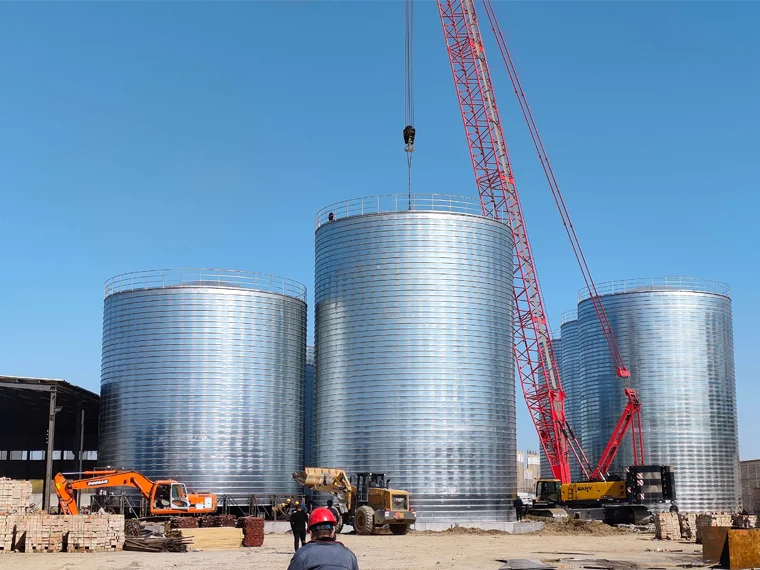
The total project cost includes not only the silo structure but also foundation preparation, installation complexity, material specifications, and regional compliance requirements. A common mistake is focusing solely on the ex-factory price of the silo while ignoring installation and civil works, which can account for 30% to 50% of the total budget. For example, in soft soil areas, the foundation treatment for a large spiral-welded silo may cost more than the silo body itself. Fur
thermore, the choice of anti-corrosion coating, the configuration of the in-feed and out-feed system, and the inclusion of intelligent systems like temperature monitoring and ventilation can significantly widen the cost gap between different proposals.Three Main Steel Silo Types: A Cost and Feature Comparison
The steel silo market is dominated by three primary structural solutions, each with distinct manufacturing methods, installation requirements, and price positioning. Understanding these differences is the first step toward accurate budget planning.
Corrugated Panel Bolted Silos
These silos use curved corrugated steel panels that achieve structural strength through their geometric design. They typically offer the most economical entry point for smaller operations. Installation may require specialized rolling equipment but involves minimal on-site welding. The cost advantage comes from modular production and rapid assembly. However, they are limited in single-unit capacity and generally have weaker sealing performance, making them more suitable for short-term storage or materials with low airtightness requirements.
Bolted Flat-Panel Silos
Constructed from flat steel plates joined by high-strength bolts, these silos are relatively simple to assemble and offer the potential for disassembly and relocation. Thi
s design excels in flexibility and scalability, allowing users to gradually increase storage capacity as production needs change. Their cost falls between corrugated panel silos and welded silos, making them a popular choice for many medium-sized grain processing plants and feed mills.Welded Steel Silos
Welded silos are fabricated either in the factory or on-site to create a continuous, seamless steel structure. They offer the best performance in terms of airtightness, structural strength, and durability, making them ideal for storing high-value grain or chemical raw materials that require strict sealing. However, their high manufacturing cost, stringent welding process requirements, and longer on-site construction period make them the most expensive option per unit of capacity among the three types.
Key Takeaways
- Key Data: For equivalent capacity, corrugated panel bolted silos typically have a 30% to 40% lower initial investment than welded silos, but welded silos may have lower whole-life maintenance costs.
- Best Practice: Always calculate the "whole-life cost" before selecting a structure type, including initial investment, installation fees, maintenance, energy consumption, and expected service life.
- Watch Out For: Do not make decisions based solely on "cost per ton of storage." Foundation conditions, local climate (wind load, snow load), and material characteristics can completely change the cost-effectiveness of different solutions.
- Pro Tip: For projects in seismic zones or high-wind areas, investing in a higher-grade steel or thicker plates is a non-negotiable safety cost, not an optional upgrade.
- Bottom Line: The cheapest upfront price often leads to the highest total cost of ownership. A comprehensive quote breakdown is your most powerful tool for accurate budget planning.
Five Key Variables That Determine Steel Silo Pricing
Beyond the structural type, these five variables have a decisive impact on the final cost and are critical factors in any budget plan.
1. Capacity and Dimensions: The diameter and height of the silo directly determine the amount of steel required. Generally, as capacity increases, the unit storage cost decreases. However, very large-diameter silos place significantly higher demands on foundations and installation equipment. For instance, a single silo with an 18-meter diameter and 22-meter height may have a 15% to 20% lower cost per ton of storage than two 12-meter diameter, 15-meter high silos.
2. Steel Grade and Thickness: Choosing between Q235B and Q355B steel, along with plate thickness, directly impacts structural strength and cost. In high-wind or seismic zones, using thicker plates or higher-grade steel is a necessary safety investment.
3. Corrosion Protection and Coating Systems: Options like hot-dip galvanizing, zinc-rich primer with polyurethane topcoat, or epoxy resin coatings vary greatly in cost and durability. For projects storing high-moisture materials or located in coastal environments, a high-quality coating system is key to extending service life.
4. In-feed, Out-feed, and Auxiliary Equipment: The configuration of conveyors, bucket elevators, sweep augers, temperature monitoring systems, and ventilation systems can account for 40% or more of the total project budget. Higher levels of automation increase initial investment but significantly reduce long-term labor costs and operational losses.
5. Installation and Civil Works: The difficulty of on-site installation, the size of required lifting equipment, and the foundation treatment plan (e.g., bored piles, raft foundations, or dynamic compaction) are the largest sources of cost fluctuation. For projects in remote areas, transportation and travel expenses for installation crews can also add significantly to the total cost.
Frequently Asked Questions
Q: Why do different manufacturers quote vastly different prices for the same specification of steel silo?
A: Price differences typically stem from several factors. First, steel procurement channels and volumes vary, leading to different raw material costs. Second, the design safety factor differs; some manufacturers use more conservative designs, increasing steel usage. Third, and most critically, whether the quote includes "hidden costs" is key—does it cover installation supervision, transport insurance, foundation design drawings, and after-sales service commitments? A low quote might only include the silo body material, while a comprehensive quote covers everything from design to commissioning. Always request a detailed line-item breakdown and compare item by item, not just the total price.
Q: For grain storage, what are the long-term cost advantages of a steel silo compared to a concrete silo?
A: The long-term cost advantages of steel silos are primarily in three areas. First, the construction period is much shorter—typically 40% to 60% faster than concrete silos—allowing for quicker operational startup and a faster return on investment. Second, steel silos are more adaptable to different foundation conditions and can be relocated if necessary, offering greater asset flexibility. Third, while concrete silos have lower initial maintenance, they are prone to cracking and moisture ingress over decades, whereas a properly coated steel silo can be more easily repaired and maintained, potentially offering a lower whole-life cost when factoring in energy efficiency for aeration systems.
Q: How do foundation conditions in soft soil or high water table areas affect the total budget for a steel silo project?
A: Foundation conditions are one of the most underestimated cost drivers. In soft soil or high water table areas, the cost of ground improvement (e.g., dynamic compaction, stone columns) or deep foundations (e.g., bored piles) can equal or even exceed the cost of the silo itself. For a large-diameter silo, this can add 30% to 50% to the total project budget. A thorough geotechnical survey before finalizing the silo design is not an optional expense—it is a critical step that prevents budget overruns and structural failure.
Q: What is the typical cost difference between a bolted flat-panel silo and a welded silo for a 5,000-ton grain storage project?
A: For a 5,000-ton grain storage project, a bolted flat-panel silo will generally have a 20% to 30% lower initial capital cost compared to a welded silo of the same capacity. However, this gap narrows when you account for the welded silo's superior airtightness, which reduces fumigation gas loss and grain spoilage risk. The bolted silo offers faster installation and potential for future expansion or relocation. The best choice depends on whether your priority is minimizing upfront capital or maximizing long-term storage quality and operational efficiency.
Q: How does the choice of coating system impact the 20-year total cost of ownership for a steel silo in a coastal environment?
A: In a coastal environment, the coating system is the single most critical factor for longevity. A standard alkyd paint system may require major recoating every 5-7 years, leading to significant recurring costs and downtime. In contrast, a high-performance system like hot-dip galvanizing or a multi-layer epoxy/polyurethane system can last 20+ years with minimal maintenance. While the initial cost of a premium coating system can be 40% to 60% higher, it can reduce the 20-year total cost of ownership by 30% or more by eliminating the need for expensive recoating and preventing structural corrosion.
Need expert manxingsilo solutions for your project?
We provide professional design, manufacturing, and installation services for bulk storage and material handling systems worldwide. Our team can help you analyze your specific site conditions, material properties, and budget constraints to recommend the most cost-effective silo solution.
Get a Free Technical Consultation →