


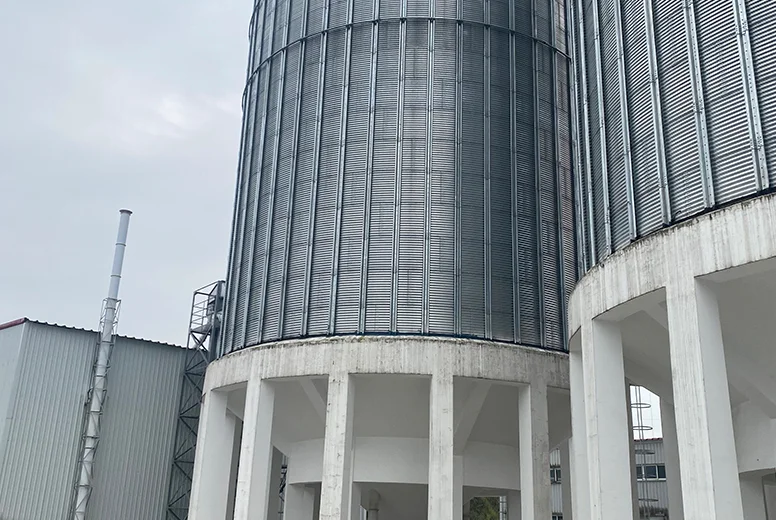
When storing highly corrosive fertilizers like urea and ammonium phosphate, concrete silos offer superior structural durability, chemical stability, and thermal performance compared to steel alternatives. With a 30–40% lower life-cycle cost and 2–3 times longer maintenance intervals, concrete silos are the preferred long-term storage solution for the agricultural and chemical industries.
The Core Advantages of Concrete Silos for Fertilizer Storage
Fertilizers—especially those containing ammonium nitrogen and phosphates—release ammonia gas, acidic vapors, and moisture during storage. These byproducts aggressively attack storage structures. Concrete silos, with their naturally alkaline environment (pH 12–13) and low permeability, effectively neutralize acidic corrosion, preventing the pitting and stress corrosion cracking common in steel silos. Research shows that under identical conditions, concrete silos require maintenance 2–3 times less frequently than steel silos, delivering a 30–40% reduction in total life-cycle costs.
Furthermore, concrete’s high heat capacity—approximately six times that of steel—provides a natural thermal buffer. In regions with large diurnal temperature swings, internal temperature fluctuations in a concrete silo are limited to ±3°C, compared to ±15°C in a steel silo. Thi
s stability directly inhibits moisture absorption, caking, and chemical reaction rates, preserving fertilizer quality over extended periods.Solving the Three Major Pain Points of Fertilizer Storage
Fertilizer storage presents three critical challenges: chemical corrosion, temperature and humidity control, and dust explosion risks during discharge. Concrete silos address all three through integrated design.
Chemical Corrosion Protection System
Modern concrete silos employ a dual strategy of “body protection plus surface coating.” The silo wall is constructed with sulfate-resistant cement (C₃A content below 5%) and a low water-to-cement ratio (≤0.40), reducing capillary porosity to less than 8%. This prevents corrosive ions from penetrating the concrete. The interior surface is then coated with epoxy resin or polyurea elastomer (thickness ≥500 μm) to create an impermeable barrier against urea, potassium chloride, and other aggressive materials. With this design, concrete silos storing highly corrosive fertilizers like monoammonium phosphate (MAP) achieve service lives exceeding 25 years.
Intelligent Temperature and Humidity Control
While concrete’s thermal mass passively dampens temperature swings, active control systems are equally important. Modern silos integrate roof-mounted natural ventilators (using thermal pressure differential to achieve 2–3 air changes per hour), embedded temperature sensor arrays on the silo wall (one sensor per 10 m²), and forced ventilation ducts at the base (adjustable airflow for emergency cooling or drying). When internal humidity exceeds 65% RH, the system automatically activates dehumidification fans to maintain the optimal 50–60% RH range for fertilizer storage.
Safe Discharge and Dust Control
The discharge hopper in a concrete silo is typically lined with stainless steel (thickness ≥6 mm) with a surface roughness of Ra ≤3.2 μm, ensuring smooth flow and preventing bridging and rat-holing. Pneumatic arch-breakers (operating at 0.4–0.6 MPa) and vibration motors handle sticky materials. At the silo roof, explosion relief vents (area ≥0.05 m² per m³ of silo volume) and dust concentration monitors are installed. When dust concentration reaches 25% of the lower explosive limit (LEL), the system automatically triggers alarms and activates the suppression system.
Key Takeaways
- Key Data: Concrete silos for fertilizer storage achieve a 30–40% lower life-cycle cost (LCC) and 2–3 times longer maintenance intervals compared to steel silos.
- Best Practice: Use sulfate-resistant cement combined with an epoxy or polyurea interior coating to ensure a service life exceeding 25 years when storing urea, MAP, and other highly corrosive fertilizers.
- Watch Out For: The discharge hopper must be lined with stainless steel (≥6 mm thick) and finished to a surface roughness of Ra ≤3.2 μm; otherwise, fertilizer caking and plugging will occur.
- Pro Tip: For optimal corrosion resistance, specify low-alkali cement (alkali content ≤0.6%) with 5–8% silica fume addition to maintain concrete pH above 12.5 and suppress urea hydrolysis.
- Bottom Line: Concrete silos are the most cost-effective, durable, and safe solution for long-term, high-volume fertilizer storage, especially in corrosive environments.
Key Design and Construction Technologies for Fertilizer Storage Silos
Designing a concrete silo for fertilizer storage requires adherence to standards such as GB 50077 (China) and ACI 313 (USA). Critical parameters include: lateral pressure coefficient for fertilizer (recommended 0.35–0.45, with a dynamic overpressure factor of 1.2–1.5), temperature stress (maximum temperature differential between concrete interior and exterior ≤25°C), and seismic design (typically considering a fortification intensity of 8). Slipform construction is standard, with a lifting speed of 3–6 meters per day to ensure continuous concrete placement and avoid cold joints. Post-tensioning with high-strength steel strands (1,860 MPa) controls crack widths to within 0.1 mm, meeting the strict sealing requirements for fertilizer storage.
Frequently Asked Questions
Q: Does urea chemically react with concrete in a silo, causing structural damage?
A: Urea (CO(NH₂)₂) hydrolyzes in humid conditions to produce ammonia and carbon dioxide. Ammonia dissolves in water to form a weak alkaline solution (pH 10–11), which is generally compatible with concrete’s calcium silicate hydrate (C-S-H) matrix. However, if ammonia gas concentration exceeds 50 ppm, it can accelerate carbonation. The solution is to use low-alkali cement (alkali content ≤0.6%) and add 5–8% silica fume to the binder, maintaining concrete pH above 12.5. Additionally, keep internal relative humidity at or below 60% to suppress urea hydrolysis.
Q: How do concrete and steel silos differ regarding dust explosion risk during fertilizer discharge?
A: Concrete silos have inherent advantages for dust explosion safety. Concrete is non-combustible and cannot act as an ignition source. Its thermal conductivity (1.7 W/m·K) is far lower than steel’s (50 W/m·K), which helps dissipate static electricity—concrete’s surface resistivity is 10⁶–10⁸ Ω compared to steel’s 10⁻⁴ Ω. However, concrete silos require more complex explosion venting designs. Because concrete is brittle, vent areas must be 20–30% larger than for steel silos to prevent dangerous fragment projection. Install lightweight explosion relief panels (opening pressure ≤0.01 MPa) with anti-fragmentation mesh.
Q: What is the recommended concrete mix design for a silo storing MAP (monoammonium phosphate)?
A: For MAP storage, use sulfate-resistant cement (C₃A content <5%) with a water-to-cement ratio of ≤0.40. Incorporate 5–8% silica fume by weight of cementitious materials to reduce capillary porosity below 8% and increase chemical resistance. The interior surface must be coated with a high-build epoxy or polyurea system at a minimum dry film thickness of 500 μm. This combination has been proven to deliver a service life exceeding 25 years in MAP storage applications.
Q: How do you prevent fertilizer caking inside a concrete silo?
A: Caking is primarily driven by moisture and temperature fluctuations. Concrete’s high thermal mass naturally limits temperature swings to ±3°C. Combine this with an active humidity control system that maintains 50–60% RH. The discharge hopper should have a stainless steel liner with Ra ≤3.2 μm to minimize friction and prevent material buildup. Install pneumatic arch-breakers and vibration motors at the hopper to break any bridges that do form. Regular rotation of stored fertilizer also helps prevent long-term compaction and caking.
Q: What maintenance schedule is typical for a concrete fertilizer silo?
A: With proper design and coating, concrete silos require major maintenance only every 10–15 years, compared to 3–5 years for steel silos. Annual inspections should include checking the interior coating integrity, verifying humidity and temperature sensor accuracy, testing dust monitoring and explosion suppression systems, and inspecting the stainless steel hopper liner for wear. Eve
ry 5 years, conduct a full structural assessment including crack width measurement (target ≤0.1 mm) and concrete pH testing.Q: Can an existing steel silo be converted to a concrete silo for fertilizer storage?
A: Direct conversion is not feasible due to fundamental differences in structural systems and foundations. However, a steel silo can be retrofitted with a concrete liner or internal coating system if the structural integrity of the steel shell is adequate. For new installations, a purpose-built concrete silo is always recommended for fertilizer storage because it provides superior corrosion resistance, thermal performance, and life-cycle economics. Retrofitting typically achieves only 50–70% of the performance of a new concrete silo.
Need expert concrete silo solutions for your fertilizer storage project?
We provide comprehensive services from geotechnical investigation and structural design to slipform construction and smart control system integration. With over 30 successful projects worldwide, our team delivers durable, cost-effective, and safe storage systems tailored to your specific fertilizer types and site conditions.
Get a Free Technical Consultation →