


Choosing between steel and concrete grain silos is one of the most capital-intensive decisions for farms and processing facilities. This decision framework, grounded in ASABE standards and USDA data, moves beyond simple material comparisons to provide a quantifiable, total-cost-of-ownership (TCO) analysis based on your specific climate, crop type, and operational timeline. Make a choice that withstands the test of time and maximizes your return on investment.
Climate Adaptability: The Defining Performance Factor for Steel vs. Concrete Silos
Climate is the primary determinant of silo performance, directly impacting grain shelf life and operational costs. In high-humidity regions like the U.S. Gulf Coast and Southeast Asia, steel silos are highly susceptible to internal condensation. When warm, moist air contacts the cooler steel wall, water vapor condenses, leading directly to localized mold growth and grain caking. Concrete silos, with their superior thermal mass, effectively buffer daily temperature swings, keeping internal temperature fluctuations within a much tighter range and significantly reducing condensation risk. However, concrete is not invulnerable—without an effective vapor barrier, moisture can slowly permeate through the porous concrete walls, also causing storage losses.
In arid, continental climates like the U.S. Great Plains, steel silos face pronounced thermal expansion and contraction issues. According to a 2026 study in the Journal of Stored Products Research, under extreme temperature differentials, the internal temperature gradient in a concrete silo can be stabilized within 3°C, whereas a steel silo can experience gradients of 6–8°C. This difference not only exacerbates "grain sweating" but also places cyclic stress on bolted connections, potentially leading to long-term structural fatigue. For coastal or high-rainfall areas, corrosion is the primary enemy of steel silos, requiring hot-dip galvanization or stainless steel construction to ensure a service life exceeding 25 years. While concrete silos are corrosion-resistant, in cold regions they must include air-entraining admixtures per ACI 318 standards to prevent surface spalling from freeze-thaw cycles.
Matching Silo Material to Crop Type and Storage Requirements
The physical and chemical properties of different crops impose specific demands on silo materials. While bulk grains like corn and wheat are relatively tolerant of temperature fluctuations, high-oil crops such as soybeans and rapeseed are extremely sensitive to their storage environment. In steel silos, these high-oil crops are prone to rapid increases in free fatty acid (FFA) levels due to localized hot spots (caused by condensation or solar radiation), which reduces oil extraction rates and market value. The stable temperature environment of a concrete silo offers a clear advantage in this scenario, extending the optimal storage period for high-value crops.
Furthermore, grain flowability is a critical consideration. The smooth interior walls of steel silos ensure high discharge efficiency, making them ideal for commercial grain depots with frequent turnover. Conversely, the higher surface roughness of concrete silos can lead to bridging and clogging issues with poorly flowing crops, such as certain varieties of paddy rice or legumes. For long-term strategic reserves (storage exceeding 12 months), the superior airtightness and temperature control of concrete silos are paramount. For fast-turnaround, short-term storage (3–6 months) of commercial grain, the rapid construction speed and lower initial cost of steel silos are more advantageous.
High-Oil Crops: The Exclusive Domain of Concrete Silos
Crops like soybeans, rapeseed, and sunflower seeds are extremely temperature-sensitive during storage. Research indicates that after six months of storage in a steel silo, the free fatty acid content of soybeans increases by an average of 0.8%, compared to only 0.3% in a concrete silo. For a large oil processing plant with an annual storage capacity exceeding 50,000 tons, this difference translates into hundreds of thousands of dollars in quality-related losses.
Bulk Grains: The Efficiency Advantage of Steel Silos
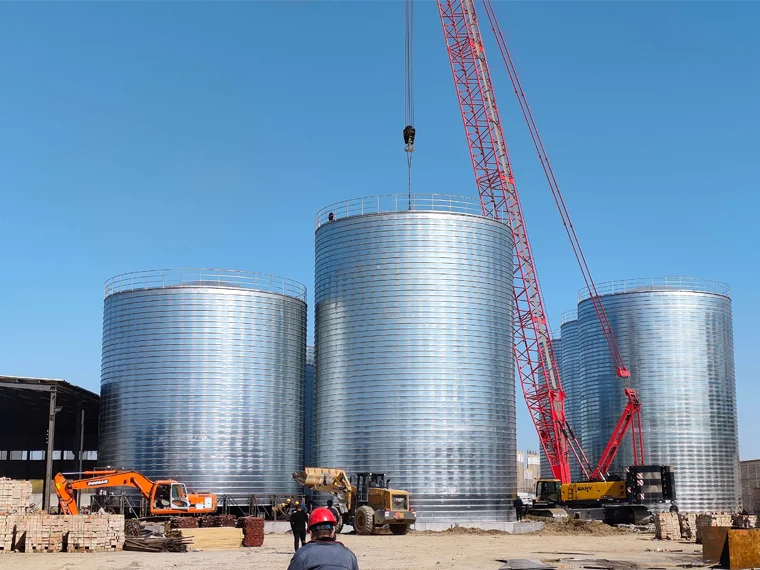
For bulk grains like corn and wheat, the rapid construction and flexible expansion capabilities of steel silos make them the preferred choice for commercial operations. A spiral-lock steel silo with an 18-meter diameter can be operational in just 45 days from foundation work, whereas a concrete silo of equivalent capacity using slipform construction requires at least 120 days. In a volatile grain market, time is money, and faster commissioning directly impacts profitability.
Key Takeaways
- Key Data: Under extreme temperature differentials, concrete silos maintain an internal temperature gradient within 3°C, while steel silos experience 6–8°C—a difference of more than 2x.
- Best Practice: Prioritize concrete silos with a vapor barrier in high-humidity regions; prioritize steel silos for high-turnover commercial grain storage to shorten the payback period.
- Watch Out For: Never use plain carbon steel silos in coastal areas without hot-dip galvanization; in freeze-thaw zones, concrete silos must include air-entraining admixtures per ACI 318.
- Pro Tip: For high-oil crops like soybeans, the stable temperature of a concrete silo can reduce free fatty acid rise by over 60% compared to steel, preserving significant value.
- Bottom Line: Your choice isn't just about material—it's a strategic decision based on climate, crop value, and holding period. Con crete wins on TCO for long-term holds; steel wins on speed and upfront cost for short-term operations.
Budget and Total Cost of Ownership (TCO): A Quantitative Analysis
Initial construction cost is the first factor most decision-makers consider, but from a full lifecycle perspective, Total Cost of Ownership (TCO) is the true basis for decision-making. Steel silos typically have an initial construction cost 20%–35% lower than concrete silos, but their maintenance costs are higher: they require recoating of corrosion protection every 5–8 years, and repairs necessitate specialized welding equipment. Concrete silos have a higher initial investment but extremely low maintenance requirements—primarily inspecting the waterproofing layer and expansion joints every 10–15 years.
According to USDA data from a 10-year tracking study of 200 silos in the Midwest, the average annual maintenance cost for steel silos is approximately 1.5% of the initial investment, compared to just 0.3% for concrete silos. For a project with a 30-year design life, the TCO of a concrete silo begins to be lower than that of a steel silo after 20 years. Therefore, for farms or cooperatives planning long-term ownership (over 20 years), concrete silos offer superior economics. For short-term operations or leased land, the low initial investment of steel silos is more attractive. Additionally, the lower cost of dismantling and relocating steel silos makes them suitable for scenarios where land use is uncertain.
Frequently Asked Questions
Q: Are steel silos completely infeasible in tropical, high-humidity regions?
A: Not completely infeasible, but they require special design measures. For example, installing forced ventilation systems at the silo top to balance internal and external temperatures, or spraying polyurethane insulation on the inner wall to reduce condensation risk. However, these additions increase steel silo costs by 15%–25%, eroding their initial price advantage. Based on real-world cases in Southeast Asia, the comprehensive cost of an insulated steel silo approaches that of a concrete silo within five years, yet its service life is still 10–15 years shorter. Unless the land lease is extremely short, concrete remains the more prudent choice.
Q: For a small farm with an annual storage capacity of less than 5,000 tons, which silo type is more economical?
A: For small-scale operations, steel silos are generally the more economical and practical choice. The lower initial investment (20%–35% less than concrete) is critical for smaller budgets. Furthermore, the ability to erect a steel silo in 45 days versus 120+ days for concrete means faster time to revenue. The higher maintenance costs of steel are less burdensome on a smaller scale, and the flexibility to relocate the silo if needed is a significant advantage for farms with uncertain long-term land tenure. Concrete's TCO benefits only become apparent after 20 years, which may exceed the planning horizon of many small farms.
Q: How does freeze-thaw cycling specifically damage concrete silos, and how can it be prevented?
A: In cold climates, water that penetrates the porous surface of concrete expands when it freezes, creating internal pressure that causes cracks and surface spalling (flaking). Over repeated cycles, this can compromise the structural integrity and airtightness of the silo. Prevention is straightforward and mandatory per ACI 318 standards: use air-entraining admixtures in the concrete mix. These create microscopic air bubbles that relieve internal pressure from freezing water, dramatically improving freeze-thaw resistance. Proper curing and the application of a high-quality waterproof sealant are also essential for long-term durability in these environments.
Q: What is "grain sweating" and why is it more dangerous in a steel silo?
A: "Grain sweating" occurs when warm, moist air within the silo rises and comes into contact with a cooler surface, causing moisture to condense. This is far more dangerous in steel silos because steel's high thermal conductivity means the silo wall temperature closely tracks outside air temperature, creating a large temperature gradient. The condensed water drips back onto the grain, creating localized wet spots that are ideal for mold growth, mycotoxin development, and grain caking. Concrete's thermal mass keeps interior surfaces warmer, reducing the temperature gradient and thus the condensation potential. The 3°C gradient in concrete vs. 6–8°C in steel directly explains this performance difference.
Q: Can a steel silo be designed to last as long as a concrete silo (30+ years)?
A: Achieving a 30+ year lifespan for a steel silo is possible but comes at a significant cost premium. It requires using stainless steel or hot-dip galvanized steel (not just painted carbon steel), a more robust foundation design to handle thermal stresses, and a rigorous maintenance schedule including recoating every 5–8 years. Even then, the corrosion risk in coastal or high-humidity areas remains a challenge. While the upfront cost might approach that of concrete, the ongoing maintenance burden is much higher. For most long-term applications, concrete still provides a more predictable and lower-maintenance path to a 30-year service life.
Need expert manxingsilo solutions for your project?
We provide professional design, manufacturing, and installation services for bulk storage and material handling systems worldwide. Our team can help you run a full TCO analysis based on your specific climate, crop, and budget.
Get a Free Technical Consultation →