


When a flood takes out your grain elevator or a fire shuts down your primary storage, you don't have 6 months for a new concrete silo. Containerized silo solutions can be operational in under 2 weeks, providing up to 500 tons of temporary storage capacity with minimal site prep. Here's what you need to know to avoid costly mistakes.
Key Takeaways
- Core Data Point: Containerized silos can be deployed in 7-14 days versus 6-12 months for permanent structures, with capacities ranging from 50 to 500 tons per unit.
- Best Practice: Always specify integrated aeration and temperature monitoring—even for temporary storage—to prevent spoilage losses that can exceed 15% of stored value.
- Risk Alert: Improper foundation preparation (assuming "any flat ground works") is the #1 cause of structural failure in containerized silo installations, especially in emergency scenarios.
Containerized Silo Design: What Makes Them Different from Permanent Silos
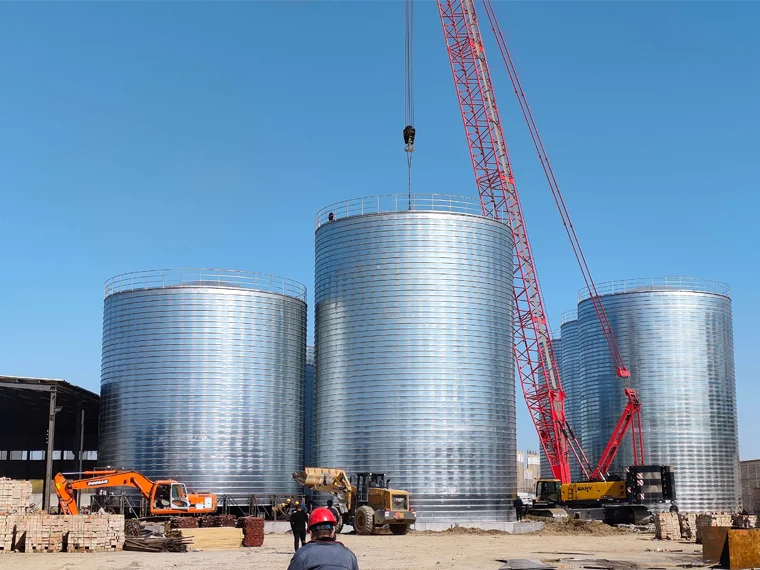
Containerized silos aren't just shipping containers with grain dumped in them. The engineered systems I've worked with use modular, bolted-steel panels that fit inside standard ISO container frames or are designed as self-contained units with integrated discharge systems. A typical 40-foot containerized unit handles 80-120 tons of wheat or corn, while larger 20-foot units designed for high-density materials like soybeans can push 150 tons. The key engineering difference is the load path: these units must handle both static grain pressures (typically 0.6-0.8 psi per foot of depth) and dynamic loads from transport and lifting.
The best designs I've seen incorporate a 45-degree or 60-degree hopper bottom with a slide gate or screw conveyor discharge. This isn't optional—flat-bottom containers require external equipment to unload, which defeats the purpose of a self-contained emergency solution. A professional manufacturer will also include roof vents (minimum 0.5 sq ft per 100 bushels) and a manhole access for inspection. In my experience, the units that fail in the field are the ones that skip these details to save $2,000 on a $50,000 system.
When Do You Actually Need a Containerized Silo? Three Real Scenarios
I've installed these systems on three continents, and the use cases break down cleanly. First: emergency crop storage after a primary silo collapse or fire. In 2019, I oversaw a project where a 5,000-ton concrete silo developed a vertical crack—we had 30 days to evacuate 3,200 tons of corn. Containerized units allowed us to save 85% of the grain that would have been written off. Second: humanitarian aid operations. After a typhoon in Southeast Asia, we deployed 12 containerized silos to store rice for 8,000 displaced families. The units were operational on concrete pads in 11 days. Third: seasonal overflow for cooperatives that need 2-3 months of extra capacity during harvest peaks.
Selection Criteria That Actually Matter
Focus on three numbers: the material's angle of repose (typically 23-28 degrees for corn, 25-30 for wheat), the required discharge rate (tons per hour), and the site's load-bearing capacity. A containerized silo filled to 120 tons exerts roughly 2,400 psf on the foundation—that's about the same as a loaded concrete truck. If your ground is soft, you'll need a 6-inch reinforced concrete pad or compacted crushed stone base. Don't skip this.
The Hidden Cost Trap: Accessories and Logistics
The unit itself is usually 60-70% of the total cost. The rest is aeration fans (3-5 HP per unit, $2,500-4,000), temperature cables ($800-1,200 per unit), and the conveyor system to fill and empty. I've seen projects where the client bought 10 containerized silos but couldn't afford the $45,000 bucket elevator to fill them. Plan for a 40-50% accessory budget on top of the silo price. Also: shipping. A 40-foot containerized silo weighs 8-12 tons empty—that's overweight for standard container shipping and requires special permits or flatbed transport.
Installation and Commissioning: The 14-Day Timeline That Works
Here's the real-world schedule I've refined over 20+ installations. Day 1-3: site survey and foundation prep (concrete curing takes 7 days, so use precast pads or compacted stone if you need speed). Day 4-6: unit delivery and positioning using a 25-ton crane. Day 7-8: assembly of hopper, aeration ducting, and discharge system. Day 9-10: installation of temperature cables and control panel. Day 11-12: seal testing and calibration of discharge rate. Day 13-14: first fill at 50% capacity, then full load after 24-hour monitoring. The most common delay? Waiting for electrical hookup. Have a 3-phase, 60-amp disconnect ready at the pad location before the silo arrives.
One practical insight from the field: always test the aeration system before loading. I've seen a fan installed backwards (pulling air down instead of pushing up) that caused moisture migration and a 40-ton crusted block of grain. Also, containerized silos have lower headroom than permanent bins—typically 8-10 feet. That means you can't use a standard grain thrower for filling; you need a low-profile conveyor or a drop tube. Plan for that in your material handling layout. For long-term temporary storage (over 3 months), I recommend adding a solar-powered ventilation system as backup—power outages during storms are when spoilage happens.
Frequently Asked Questions
Q: Can containerized silos be used for materials other than grain, like fertilizer or plastic pellets?
A: Yes, but you need to specify the material's bulk density and flow characteristics. Fertilizers like urea (45-50 lbs/cu ft) and DAP (55-60 lbs/cu ft) require stronger hopper construction and often stainless steel liners to prevent corrosion. Plastic pellets (35-40 lbs/cu ft) are easier but may need anti-static grounding. Always provide the manufacturer with the material's angle of repose and moisture content—it affects the hopper angle design.
Q: How do you prevent condensation inside a containerized silo, especially in humid climates?
A: Condensation is the #1 spoilage risk in temporary storage. The solution is active aeration: a minimum of 0.1 CFM per bushel for drying, and 0.05 CFM per bushel for cooling. In tropical environments, I add a dehumidification unit on the aeration intake. Also, insulate the roof panels (R-10 minimum) to reduce temperature differential. Never seal the unit airtight—you need controlled ventilation.
Q: What's the maximum practical storage duration in a containerized silo?
A: With proper aeration and temperature monitoring, 6-8 months is achievable for dry grain (below 14% moisture). Beyond that, you risk quality degradation even with perfect conditions. For longer durations, I recommend transferring to a permanent flat-bottom silo with long service life. The containerized units are best for bridging a 3-6 month gap.
Q: Are containerized silos code-compliant for grain storage in North America or Europe?
A: They must meet NFPA 61 (agricultural dust) and local building codes. The key requirements are: grounded construction to prevent static sparks, explosion venting (minimum 1 sq ft per 20 cubic feet of bin volume), and dust collection at the fill point. A professional manufacturer will certify compliance. I've seen customs reject non-compliant units at port—check regulations before ordering.
Q: How do you unload a containerized silo if the discharge system fails?
A: Always include a backup discharge method. I specify a 12-inch cleanout door on the hopper side wall, plus a top-mounted vacuum port for pneumatic unloading. In an emergency, you can also tilt the container using a crane and gravity-discharge through the top door—but that's a last resort. Have a 6-inch flexible auger on site as contingency.
Q: Can containerized silos be stacked or combined for larger capacity?
A: Stacking is possible but rare—it requires a structural steel and increases the center of gravity significantly. I've done it for a 2-high stack in a controlled environment, but it's not recommended for temporary installations due to wind load risks. A better approach is to link multiple units with a common conveyor system. For a poultry feed silo buyer's guide, you'll see that modular, side-by-side layouts are safer and more practical.
Looking for Professional Silo Storage Solutions?
We provide customized design, manufacturing, and installation services for steel silo systems worldwide. Whether you need emergency storage or a permanent flat-bottom silo with strong roof support, our team delivers turn-key solutions with 15+ years of field experience.
Get Your Free Technical Consultation →