


Choosing the wrong steel grade for your silo can lead to catastrophic structural failure, costly product contamination, or even collapse. With over 15 years of expertise in industrial bulk storage, we break down the critical differences between carbon steel, galvanized steel, and stainless steel, providing a definitive guide to selecting the right material for grain, cement, and chemical storage applications.
Steel Grades for Silos: Balancing Structural Integrity and Cost-Effectiveness
The grade of steel used in silo manufacturing directly dictates the structure's lifespan, safety, and overall performance. For
most industrial applications, carbon steel remains the industry standard due to its excellent strength-to-weight ratio and cost efficiency. ASTM A36, a low-carbon steel, is widely used for small to medium-sized silos due to its superior weldability. For larger, heavy-load silos, however, ASTM A572 (Grade 50 or 65) is preferred. This high-strength low-alloy (HSLA) steel allows for thinner wall panels without compromising structural integrity, significantly reducing overall weight and material costs.In the international manufacturing landscape, particularly in China, Q235 and Q345 steel grades are the direct equivalents of A36 and A572, respectively. Q345B, with its enhanced durability, has become the go-to choice for large-scale grain storage silos. The decision between these grades hinges on specific load requirements, local building codes, and the need to minimize transportation and erection costs without sacrificing safety.
Hot-Dip Galvanized Steel: The Gold Standard for Agricultural Storage
For grain storage, hot-dip galvanized steel is universally recognized as the gold standard. This process involves immersing steel components in molten zinc, creating a robust metallurgical bond that offers exceptional protection against atmospheric corrosion. The protective layer’s thickness is expressed by its weight per square meter, ranging from Z275 to Z600. In coastal or high-humidity environments, a Z450 or Z600 coating is recommended, ensuring a maintenance-free service life of over 30 years.
The Structural Advantage of Corrugated Galvanized Sheets
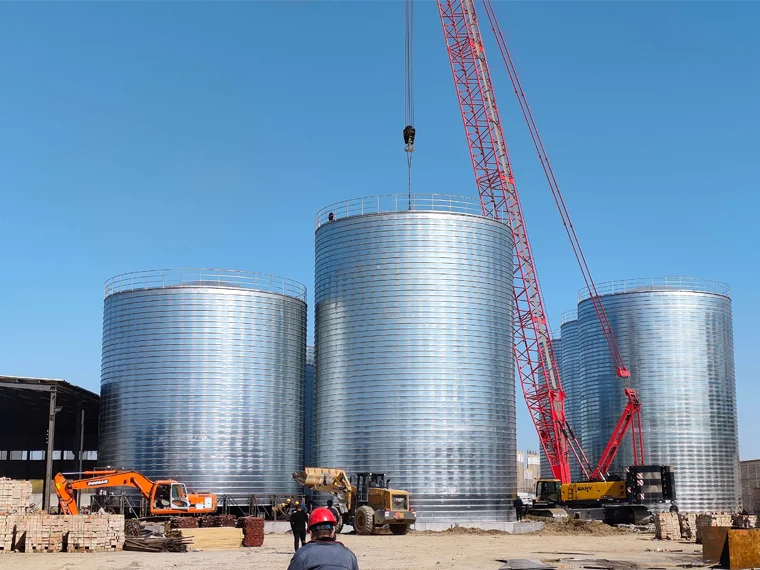
Most agricultural silos utilize corrugated galvanized sheets. The unique corrugated profile provides significant "hoop strength," which is essential for resisting the lateral pressure exerted by stored grain. This design allows for the use of thinner base steel (typically 1.5–3.0mm) while maintaining structural rigidity, reducing overall steel consumption by approximately 15%–20% compared to flat panels.
Zinc Coating Thickness: A Critical Selection Factor
Selecting the correct zinc coating is a balance between environmental exposure and budget. For inland, dry climates, Z275 is sufficient for a 20-year service life. However, for coastal or chemical plant environments, Z600 or higher is mandatory. An overly thin coating can lead to rust spots within 5–8 years, while an excessively thick coating can drive up costs unnecessarily. The key is to match the coating weight to the specific corrosion risk of the installation site.
Key Takeaways
- Key Data: Hot-dip galvanized steel (Z450+) in coastal environments offers a lifespan of over 30 years—3 to 5 times longer than uncoated carbon steel.
- Best Practice: For grain silos, prioritize Q345B or ASTM A572 Grade 50 with a Z450 galvanized coating for the optimal balance of strength and corrosion resistance.
- Watch Out For: Avoid using bare carbon steel in chemical or food processing environments. You must upgrade to 304 or 316 stainless steel to prevent chemical attack and product contamination.
- Pro Tip: When specifying corrugated sheets, ensure the forming process doesn't crack the galvanized layer. A high-quality cold-forming process maintains coating integrity, preserving the full corrosion protection.
- Bottom Line: The correct steel grade is not just about material cost; it is a critical decision that impacts silo safety, longevity, and the purity of the stored product. Related: The Impact of Stored Material on Silo Design >
Stainless Steel Silos: The Ultimate Solution for Food and Chemical Industries
When hygiene, sanitation, or extreme corrosion resistance is the primary concern, stainless steel is the only viable option. This is common in the pharmaceutical, food processing (e.g., flour, sugar), and chemical industries. Grade 304, the standard "food-grade" stainless steel, offers excellent resistance to most oxidizing acids and is easy to clean and sanitize. For more aggressive environments, Grade 316 is required. Its addition of molybdenum provides superior resistance to chlorides (e.g., saltwater, bleaches), making it ideal for coastal silos or processes involving halogen compounds.
While the initial cost of stainless steel is typically 2–3 times that of carbon steel, its total lifecycle cost is often lower. Stainless steel eliminates the need for painting or re-galvanizing, reduces downtime for maintenance, and prevents costly product recalls caused by rust contamination. For high-value products like pharmaceuticals or specialty chemicals, this investment is quickly justified.
Frequently Asked Questions
Q: Can Q345B and ASTM A572 Grade 50 be used interchangeably in silo fabrication?
A: They are chemically and mechanically similar, but not directly interchangeable without careful review. Q345B has a yield strength of ~345 MPa, matching A572 Grade 50. However, the impact toughness requirements differ. In export projects designed to American standards, using A572 is recommended to ensure full compliance. Many Chinese factories use Q345B as a substitute, but this requires additional welding procedure qualification (WPQ) and mechanical property verification, especially for wall plates exceeding 25mm in thickness.
Q: Can localized rust on a galvanized grain silo be repaired on-site?
A: On-site repair is possible but has limited effectiveness compared to the original factory coating. Localized rust is often caused by mechanical scratches during transport or installation. The repair process involves grinding down to the base metal, applying a zinc-rich primer (zinc content ≥92%), and then a cold galvanizing paint. However, the adhesion and long-term durability of this repair are far inferior to the original hot-dip galvanized layer (which is a zinc-iron alloy layer of 80–150μm). We recommend specifying in your purchase contract that all sheets be hot-dip galvanized before delivery and protected with film or cardboard for shipping.
Q: How can we prevent the risk of "intergranular corrosion" in welded stainless steel silos?
A: This is a common issue, particularly in the heat-affected zone (HAZ) of 304 stainless steel when exposed to temperatures between 450–850°C during welding. Prevention strategies include: 1) Using low-carbon grades like 304L (carbon ≤0.03%), which significantly reduces carbide precipitation. 2) Performing solution heat treatment (heating to 1010–1120°C followed by rapid quenching) immediately after welding. 3) For large silos where heat treatment is impractical, specify stabilized grades like 321 or 347. Always include detailed welding procedures in your design specifications and require third-party intergranular corrosion testing per ASTM A262 Practice E.
Q: What is the typical wall thickness for a large-diameter grain silo using high-strength steel?
A: The thickness depends on the silo diameter, height, and stored material properties. For a large grain silo (e.g., 15–20m diameter) using ASTM A572 Grade 50, wall thickness typically ranges from 2.5mm to 6.0mm. The lower sections, which bear the highest pressure, use thicker plates, while the upper sections can be thinner. Using high-strength steel allows for a wall thickness reduction of 15–25% compared to standard A36 steel, leading to significant material savings.
Q: Is it cost-effective to use stainless steel for a large cement silo?
A: Generally, no. Cement is not corrosive to carbon steel, and its storage does not require the hygiene standards of food. The primary concerns for cement silos are abrasion and structural strength. Using Q355B (or A572 Grade 50) carbon steel with a standard paint system is the most cost-effective solution. Stainless steel would be an unnecessary expense, increasing the project cost by 200-300% without providing any functional benefit for cement storage.
Need expert manxingsilo solutions for your project?
We provide professional design, manufacturing, and installation services for bulk storage and material handling systems worldwide, ensuring your silo meets ASME, GB, and EU standards.
Get a Free Technical Consultation →