


In bulk material storage, the flat bottom silo is the industry standard for high-capacity, cost-effective storage. However, its long-term structural integrity and operational safety are entirely dependent on a meticulously engineered foundation. This guide provides a deep technical analysis of flat bottom silo foundation design, covering critical load analysis, drainage systems, and common engineering pitfalls that can lead to catastrophic failure.
Core Design Principles and Industry Applications of Flat Bottom Silo Foundations
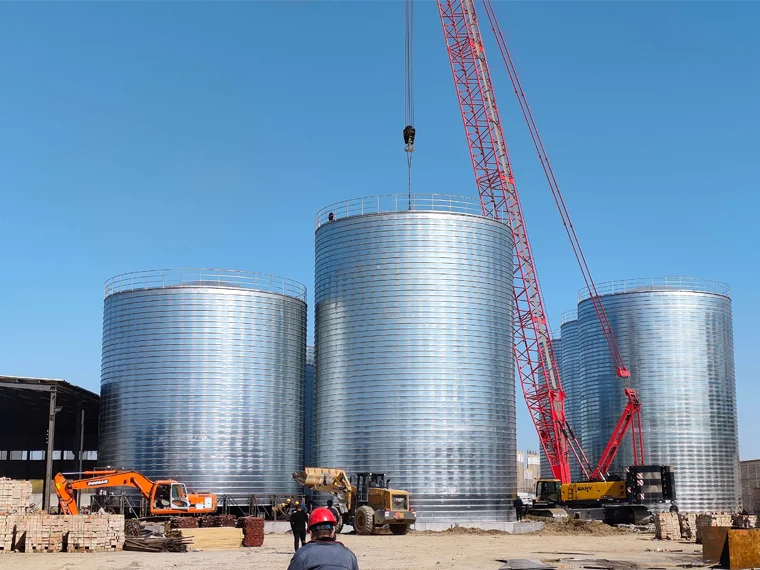
Unlike hopper-bottom or cone-bottom silos, a flat bottom silo features a flat or slightly sloped steel floor that rests directly on a robust foundation. Thi
s design offers three primary advantages: uniform load distribution, as the flat rigid bottom ensures the stored material's weight is transferred evenly to the foundation, preventing stress concentrations that cause localized failure; superior maintenance and cleaning accessibility, as the flat surface allows personnel to easily enter for inspection, cleaning, and repairs, which is critical for facilities that frequently change stored materials; and structural simplicity, which streamlines foundation design and construction, typically reducing project timelines and costs.In practice, flat bottom silo foundations are the preferred solution for industries requiring massive storage capacities, such as cement plants, mining operations, and large flour mills. They are also highly attractive for facilities with frequent discharge cycles due to their gravity flow characteristics and ease of maintenance. In challenging environmental conditions—including seismic zones, flood-prone areas, or sites with soft soil—a carefully engineered foundation is the absolute prerequisite for operational safety and service life.
Three Critical Challenges in Flat Bottom Silo Foundation Engineering
A qualified flat bottom silo foundation design must simultaneously address structural loads, environmental forces, and operational dynamics. Neglecting any of these can lead to disastrous consequences.
1. Load Analysis and Differential Settlement Control
The first step in foundation design is accurately calculating static loads (the silo's self-weight plus the stored material) and dynamic loads (discharge impact, wind load, and seismic action). For flat bottom silos, material pressure distribution is not perfectly uniform—vertical pressure near the silo wall is significantly higher than at the center. Foundation design must account for this "pressure redistribution" phenomenon, using raft foundations or pile foundations to transfer loads to a bearing stratum with sufficient capacity. Differential settlement is the most common failure mode for flat bottom silos. Once the settlement difference exceeds the allowable limit—typically 1/500 of the silo diameter—the silo wall experiences additional bending moments, leading to steel plate buckling or weld cracking.
2. Drainage and Moisture Barrier Systems
Because the flat bottom silo floor is in direct contact with the ground, moisture ingress is a primary cause of material caking, floor corrosion, and foundation weakening. The design must incorporate a ring drainage ditch, a waterproof vapor barrier, and a floor ventilation system. In areas with heavy rainfall or high groundwater tables, subsurface drainage or dewatering wells should be added to keep the foundation soil dry. A frequently overlooked detail is the seal between the silo floor plate and the concrete foundation—if this seal fails, capillary water will rise along the steel plate edge, accelerating corrosion.
3. Integrated Design of Discharge Tunnels and Foundation
Flat bottom silos typically require underground discharge galleries or belt conveyor tunnels. These structures must be designed integrally with the foundation to avoid differential settlement caused by stiffness differences. A common mistake is constructing the discharge tunnel as an independent structure, leading to a "step-like" settlement gap between the tunnel and the silo foundation. This misaligns discharge equipment and can even jam the belt conveyor. The best practice is to use a combined foundation, pouring the silo base slab and the discharge tunnel floor as a single monolithic structure, or using settlement joints and flexible connections to accommodate differential deformation.
Key Takeaways
- Key Data: The allowable differential settlement for a flat bottom silo foundation is typically 1/500 of the silo diameter. Exceeding this creates secondary stresses that cause wall buckling.
- Best Practice: On soft soil, prioritize vibro-replacement stone columns or CFG piles for ground improvement. This can effectively control total settlement to within 50mm.
- Watch Out For: Never neglect floor drainage design. For a 20m diameter flat bottom silo, just 10cm of standing water on the floor creates an additional 30 tons of load and accelerates steel corrosion.
- Pro Tip: The secondary grouting layer between the silo floor plate and the concrete foundation must be fully compacted. Voids here will lead to local plate instability under material load.
- Bottom Line: A successful flat bottom silo foundation is not just about bearing capacity; it is a holistic system that manages load distribution, groundwater, and operational structures as one integrated unit.
Foundation Type Selection and Construction Quality Control
The choice of foundation type depends on site conditions and load magnitude. For good ground with a bearing capacity of ≥200 kPa, a reinforced concrete raft foundation is suitable, typically 0.5–1.2m thick, with a reinforcement ratio that satisfies punching shear and bending requirements. For weak soils, such as silty clay or fill, pile foundations are mandatory. Prestressed pipe piles or cast-in-place piles can be used, with the pile tip penetrating at least 2m into the bearing stratum. Key control points during construction include: foundation bearing capacity verification via plate load tests, concrete pouring quality to prevent cold joints and honeycombing, and anchor bolt installation accuracy, which must be within a 5mm deviation. A repeatedly proven lesson is that the secondary grouting layer between the silo floor plate and the foundation must be fully dense; otherwise, voids will form under material load, leading to local steel plate instability.
Furthermore, for flat bottom silos located in seismic zones, the foundation design must also satisfy liquefaction resistance and seismic bearing capacity requirements. A combined raft-plus-pile foundation is recommended, verified by dynamic time-history analysis to assess settlement and tilt under earthquake loading. After construction, static load tests and settlement monitoring should be conducted, with a long-term monitoring record established.
Frequently Asked Questions
Q: What is the most commonly overlooked "hidden load" in flat bottom silo foundation design?
A: The two most critical hidden loads are thermal stress and dynamic lateral pressure. When storing high-temperature materials like cement clinker, which can reach 150°C, a significant temperature differential develops between the silo floor plate and the concrete foundation. This causes the steel plate to expand under restraint, generating compressive stress that can lead to plate bulging or weld tearing. Additionally, when storing free-flowing materials like soybeans or corn, the instantaneous discharge creates a dynamic lateral pressure peak that can be 1.5 to 2 times the static pressure. The foundation design must account for this impact effect; otherwise, the lower portion of the silo wall is prone to outward bulging.
Q: For an existing flat bottom silo, how can field personnel quickly determine if dangerous differential settlement is occurring?
A: Three on-site indicators can be used for a rapid assessment. First, check the silo wall verticality using a theodolite to measure the displacement of the wall top relative to the base. If the tilt exceeds 1/200 of the silo height, an immediate structural evaluation is required. Second, inspect the condition of the seal between the silo wall and the ground slab. If the sealant strip shows signs of tearing, compression, or separation, it indicates relative movement. Third, look for cracks or gaps in the concrete floor around the silo perimeter, especially near the discharge tunnel interface, as these are clear signs of differential settlement in progress.
Q: What is the recommended foundation solution for a flat bottom silo built on reclaimed land or very soft marine clay?
A: For such challenging ground conditions, a piled raft foundation is the industry standard. The piles, typically large-diameter bored piles or driven prestressed concrete piles, are designed to transfer the full load to a deep, competent bearing stratum, bypassing the compressible upper layers. The raft slab ties the pile caps together, providing additional stiffness to distribute loads and control differential settlement. Pre-construction ground improvement, such as vertical drains (PVDs) with surcharge preloading, is often necessary to accelerate consolidation and reduce post-construction settlement of the surrounding area. A rigorous settlement monitoring program using precise leveling points on the silo wall is essential for the first two years of operation.
Q: How does the foundation design differ for a flat bottom silo storing cement versus one storing grain?
A: While the fundamental principles are the same, the critical design parameters differ significantly. For a cement silo, the primary concern is thermal stress from the hot material (up to 150°C), requiring special attention to the expansion joint design and the heat resistance of the waterproofing membrane. The foundation must also resist chemical attack from cement dust. For a grain silo, the key challenge is moisture control. The foundation must incorporate a robust vapor barrier and ventilation system to prevent condensation and mold growth. Dynamic loads during pneumatic filling and rapid discharge are also more pronounced in grain handling, requiring a higher safety factor against lateral pressure. In both cases, the allowable differential settlement remains the critical structural limit.
Q: What is the proper procedure for conducting a plate load test on a flat bottom silo foundation?
A: The plate load test is performed to verify the bearing capacity and settlement characteristics of the foundation soil. The test plate should be at least 0.3m x 0.3m, but ideally 0.6m x 0.6m or larger, and must be placed at the actual foundation bearing level. The test is conducted in increments, typically up to 1.5 to 2 times the design bearing pressure. Settlement is recorded at each load increment using dial gauges, and the load is held until settlement stabilizes (usually less than 0.1mm per hour). A minimum of one test per 500m² of foundation area is recommended, with at least three tests for any single silo. The results are plotted on a load-settlement curve to determine the ultimate bearing capacity and the modulus of subgrade reaction, which are then compared to the design assumptions.
Need expert manxingsilo solutions for your project?
We provide professional design, manufacturing, and installation services for bulk storage and material handling systems worldwide. Our engineering team specializes in complex foundation designs for flat bottom silos in challenging ground conditions.
Get a Free Technical Consultation →